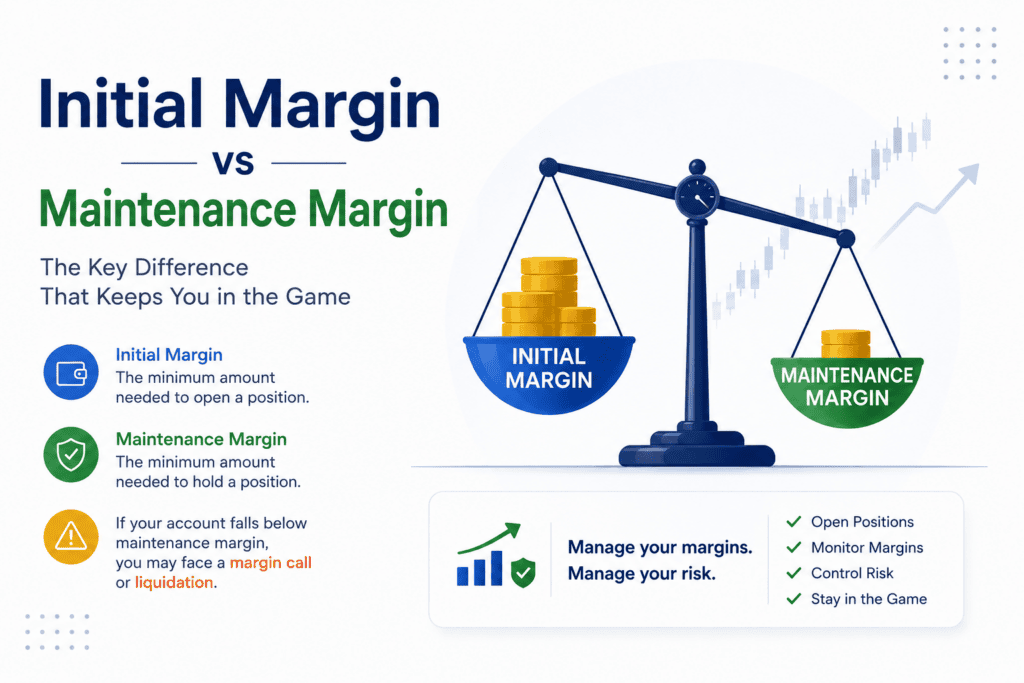
Initial margin is the minimum collateral required to open a leveraged position. Maintenance margin is the minimum collateral you must keep to prevent that position from being liquidated.
The difference matters because opening a trade and keeping it open are two separate calculations. A position may meet the initial margin requirement when you enter, then move toward liquidation as losses reduce your available margin.
Here is the basic relationship:
| Term | What it means |
|---|---|
| Initial margin | Collateral required to open the position |
| Maintenance margin | Minimum collateral required to keep it open |
| Margin balance | Collateral currently supporting the position |
| Liquidation | Forced closing or reduction when margin becomes insufficient |
The exact formulas vary by exchange, contract, margin mode, and trading platform. But the underlying logic is similar across most leveraged markets.
What Is Initial Margin?
Initial margin is the amount of collateral you need to open a leveraged position.
If a platform offers 10x leverage, a simplified initial margin calculation is:
Initial margin = Position value ÷ Leverage
Suppose you want to open a ₹1,00,000 position using 10x leverage:
₹1,00,000 ÷ 10 = ₹10,000
You need ₹10,000 in initial margin to control a ₹1,00,000 position, ignoring fees and any additional margin requirements.
That is the attraction of leverage. You get greater market exposure with less capital.
It is also the risk.
A 1% move in the ₹1,00,000 position equals ₹1,000. Relative to your ₹10,000 initial margin, that represents a 10% change before accounting for fees and other adjustments.
How Does Leverage Affect Initial Margin?
Higher leverage generally means a lower initial margin requirement for the same position size.
| Position value | Leverage | Simplified initial margin |
|---|---|---|
| ₹1,00,000 | 2x | ₹50,000 |
| ₹1,00,000 | 5x | ₹20,000 |
| ₹1,00,000 | 10x | ₹10,000 |
| ₹1,00,000 | 20x | ₹5,000 |
The position remains ₹1,00,000 in every example. Only the amount of capital supporting it changes.
At 20x leverage, a relatively small adverse price move can consume a large part of the ₹5,000 margin.
What Is Maintenance Margin?
Maintenance margin is the minimum amount of margin that must remain available to support an open leveraged position.
It acts as a safety threshold.
Suppose you open a ₹1,00,000 position with:
- Initial margin: ₹10,000
- Maintenance margin requirement: ₹5,000
If losses reduce the margin supporting the position to ₹5,000, you are approaching the platform’s liquidation threshold.
In a deliberately simplified example:
Margin balance = Initial margin + Unrealised P&L
If your position has an unrealized loss of ₹4,000:
₹10,000 – ₹4,000 = ₹6,000
You remain above the ₹5,000 maintenance requirement.
If the loss reaches ₹5,000:
₹10,000 – ₹5,000 = ₹5,000
You have reached the simplified maintenance margin threshold.
Real liquidation engines can be more complex. Fees, funding, mark price, tiered maintenance requirements, additional collateral, and other open positions may affect the actual trigger.
Initial Margin vs Maintenance Margin
The easiest way to understand initial margin vs maintenance margin is to think of two checkpoints.
Initial margin asks:
“Do you have enough collateral to open this trade?”
Maintenance margin asks:
“Do you still have enough collateral to keep this trade open?”
| Initial margin | Maintenance margin |
|---|---|
| Checked when opening a position | Applies while the position remains open |
| Determines how much collateral you initially need | Determines the minimum margin you must maintain |
| Closely linked to selected leverage | Often based on position size and risk tiers |
| Usually higher than maintenance margin | Usually lower than initial margin |
| Falling below it does not describe liquidation after entry | Breaching this threshold can trigger liquidation procedures |
What Is Liquidation in Leveraged Trading?
Liquidation is the forced closing or reduction of a leveraged position when the trader no longer has sufficient margin to satisfy the platform’s requirements.
Without a liquidation mechanism, losses could exceed the collateral supporting the trade, potentially causing losses for the platform or other market participants.
The process commonly looks like this:
- You deposit collateral.
- You open a leveraged position.
- The market moves against you.
- Your unrealized loss increases.
- Your available margin falls.
- Your margin reaches the required liquidation threshold.
- The platform’s liquidation process is triggered.
Importantly, liquidation does not necessarily wait until your margin reaches zero.
The maintenance requirement creates a buffer before that point.
The Numbers Behind a Liquidation
Consider a simplified long position.
You have:
- Trading capital allocated: ₹10,000
- Position size: ₹1,00,000
- Leverage: 10x
- Entry price: ₹100
- Position quantity: 1,000 units
- Maintenance margin: ₹5,000
Your initial margin is:
₹1,00,000 ÷ 10 = ₹10,000
Now suppose the asset falls from ₹100 to ₹97.
Your loss is:
₹3 × 1,000 = ₹3,000
Remaining margin:
₹10,000 – ₹3,000 = ₹7,000
You are still above the ₹5,000 maintenance threshold.
Now suppose the price falls to ₹95.
Your unrealized loss becomes:
₹5 × 1,000 = ₹5,000
Remaining margin:
₹10,000 – ₹5,000 = ₹5,000
In this simplified example, you have reached the maintenance margin threshold.
This is where liquidation risk becomes immediate.
Why Isn’t the Liquidation Price ₹90?
This is a common misunderstanding.
You started with ₹10,000 of collateral, so it may seem that a ₹10 fall from ₹100 to ₹90 would consume the entire ₹10,000:
₹10 × 1,000 = ₹10,000
Mathematically, yes.
But the platform generally cannot wait for your collateral to reach zero. It needs a buffer to close the position while leaving some margin.
That is what the maintenance margin requirement provides.
With the simplified ₹5,000 maintenance requirement above, the threshold is reached around ₹95 rather than ₹90.
How Is Liquidation Price Calculated?
There is no single liquidation formula that applies to every trading platform.
For a basic educational model of a long position, you can think of the liquidation threshold as the point where:
Margin balance ≈ Maintenance margin requirement
Using:
Margin balance = Initial margin + Unrealised P&L
For a long position:
Unrealized P&L = (Current price – Entry price) × Quantity
Combining the two gives you a simplified way to estimate where the maintenance threshold may be reached.
Simplified Long Position Example
Suppose:
- Entry price = ₹2,000
- Quantity = 10
- Position value = ₹20,000
- Initial margin = ₹4,000
- Maintenance margin = ₹1,000
The position can absorb approximately:
₹4,000 – ₹1,000 = ₹3,000
of losses before reaching the maintenance threshold.
Loss per unit:
₹3,000 ÷ 10 = ₹300
Simplified threshold price:
₹2,000 – ₹300 = ₹1,700
So the maintenance threshold would be around ₹1,700 under these assumptions.
This is an illustration, not a platform-specific liquidation price.
How Does Liquidation Work for a Short Position?
The logic reverses for a short trade.
A long position loses money when the price falls. A short position loses money when the price rises.
Suppose you short 1,000 units at ₹100.
If the price rises to ₹103:
Loss = ₹3 × 1,000 = ₹3,000
If your initial margin was ₹10,000, your simplified remaining margin becomes:
₹10,000 – ₹3,000 = ₹7,000
As the market continues higher, the position moves closer to its maintenance threshold and potential liquidation.
Why Does Higher Leverage Move Liquidation Closer?
Higher leverage means less initial collateral is required to support the same market exposure.
Consider a ₹1,00,000 position:
| Leverage | Initial margin | Capital supporting ₹1 lakh exposure |
|---|---|---|
| 2x | ₹50,000 | High |
| 5x | ₹20,000 | Moderate |
| 10x | ₹10,000 | Lower |
| 20x | ₹5,000 | Much lower |
The market does not need to move as far against a highly leveraged position before losses consume the margin buffer.
This is why 20x leverage is not simply “twice as aggressive” as 10x in practical risk terms. Your collateral cushion for the same position value is cut in half.
What Is Mark Price, and Why Does It Matter for Liquidation?
On many crypto derivatives platforms, liquidation is based on a mark price rather than simply the last traded price.
The last traded price is the price of the most recent transaction. During volatile markets, an isolated trade can occur at an unusually high or low price.
A mark price is designed to provide a more representative reference price, often using index pricing and other platform-defined inputs.
This means your screen might show a last traded price that has not crossed your displayed liquidation level while the platform’s mark price has reached the relevant threshold.
Before using leverage, check which price your platform uses for:
- Unrealised P&L
- Maintenance margin calculations
- Liquidation
- Position risk indicators
What Is Isolated Margin?
Isolated margin limits the collateral assigned to a particular position.
Suppose you have ₹50,000 in your derivatives account but allocate ₹10,000 as isolated margin to one trade.
If that trade performs badly, the position generally has access to the collateral specifically assigned to it, subject to the platform’s rules.
This makes the amount at risk easier to define.
Adding more isolated margin can move the liquidation threshold farther away, but it also means more of your capital is exposed to that position.
What Is Cross Margin?
Cross margin allows the use of available collateral in the relevant account or margin pool to support open positions.
Suppose you have a losing position that would have exhausted its isolated margin. Under cross margin, additional eligible account collateral may help keep it above the maintenance requirement.
That can delay liquidation.
It can also expose a larger portion of your account balance to losses.
Isolated Margin vs Cross Margin
| Isolated margin | Cross margin |
|---|---|
| Margin allocated to a specific position | Eligible collateral is shared |
| Easier to limit collateral committed to one trade | Other available collateral may support losing positions |
| Liquidation may occur sooner if little margin is assigned | Additional collateral can move liquidation farther away |
| Helps separate position risk | Can expose more of the account to a bad trade |
Neither mode automatically makes leveraged trading safe.
What Is a Margin Call?
A margin call is a warning or requirement to provide additional collateral when an account’s margin falls below a specified level.
In traditional leveraged markets, traders may have an opportunity to deposit more collateral after receiving a margin call.
Crypto derivatives can move much faster.
Automated liquidation systems may begin closing positions when the required threshold is reached, particularly during volatile markets. You should not assume you will always receive a warning with enough time to transfer funds.
What Happens During Liquidation?
The exact process is platform-specific.
A derivatives platform may:
- Cancel open orders
- Reduce part of the position
- Close the entire position
- Charge liquidation-related fees
- Use an insurance fund in certain circumstances
- Apply an auto-deleveraging mechanism under extreme conditions
A position’s displayed liquidation price should therefore be treated as a risk boundary, not as a target for exiting.
What Is Partial Liquidation?
Some platforms use partial liquidation rather than immediately closing an entire position.
The system reduces the position size to lower its margin requirement.
For example, if a ₹5 lakh position breaches its required margin level, the platform might reduce part of the position rather than liquidating the entire ₹5 lakh exposure at once.
The exact mechanism depends on the platform’s risk engine and position tiers.
How Do Funding Fees Affect Liquidation?
Perpetual futures commonly use funding payments between long and short positions to help keep the contract price aligned with the underlying spot market.
Depending on the funding rate and your position, you may pay or receive funding.
If funding payments are deducted from collateral supporting your position, repeated payments can reduce your margin buffer.
That means a position can move closer to liquidation even without a dramatic change in the underlying asset price.
Trading and liquidation fees may also affect the final calculation.
Can You Get Liquidated Even With Money in Your Account?
Yes.
This can happen when the money is not eligible to support the position.
For example, you might have:
- Collateral assigned to another isolated position
- Funds in a different wallet or account
- Assets that are not accepted as margin
- Collateral subject to a valuation haircut
- Funds tied up in open orders
Seeing ₹1 lakh somewhere in your trading account does not necessarily mean the full ₹1 lakh is protecting every leveraged position.
Why Can the Liquidation Price Change After Opening a Trade?
Your estimated liquidation price may change after entry.
Common reasons include:
- Adding or withdrawing margin
- Increasing or reducing the position
- Funding payments
- Trading fees
- Changes in maintenance margin tiers
- Changes to eligible collateral
- Other positions under cross margin
- Platform-specific risk calculations
This is why manually calculating liquidation once at entry is not enough. Monitor the platform’s current margin metrics while the trade remains open.
How Can Traders Reduce Liquidation Risk?
The most effective approach is to avoid using the maximum leverage available simply because the platform offers it.
Practical risk controls include:
- Use lower leverage. More collateral relative to exposure generally provides a larger buffer.
- Keep position sizes manageable. A smaller position reduces the rupee impact of each price movement.
- Know your maintenance margin. Do not focus only on the initial margin shown on the order screen.
- Understand your margin mode. Cross and isolated margin expose your capital differently.
- Plan exits before liquidation. A liquidation engine should not be your stop-loss strategy.
- Account for fees and funding. Both can reduce the margin available to support a position.
- Monitor risk tiers. Larger positions may have higher maintenance requirements.
Most importantly, calculate the potential loss in rupees, not just the percentage move in the asset.
Initial Margin vs Maintenance Margin: A Complete Example
Suppose a trader has ₹25,000 and opens a ₹1,00,000 long position at ₹1,000 per unit.
For simplicity:
- Position size: ₹1,00,000
- Quantity: 100 units
- Entry price: ₹1,000
- Leverage: 4x
- Initial margin: ₹25,000
- Assumed maintenance margin: ₹5,000
The trade can absorb approximately:
₹25,000 – ₹5,000 = ₹20,000
in losses before reaching the simplified maintenance threshold.
Since the trader owns exposure to 100 units:
₹20,000 ÷ 100 = ₹200 loss per unit
That produces a simplified threshold around:
₹1,000 – ₹200 = ₹800
Now imagine the trader instead uses 10x leverage on the same ₹1,00,000 position.
Initial margin becomes:
₹1,00,000 ÷ 10 = ₹10,000
Using the same assumed ₹5,000 maintenance requirement purely for illustration, the loss buffer becomes only:
₹10,000 – ₹5,000 = ₹5,000
That equals:
₹5,000 ÷ 100 = ₹50 per unit
The simplified threshold would now be around ₹950.
Same ₹1 lakh exposure, much smaller room for error.
FAQs About Initial and Maintenance Margin
What is the main difference between initial margin and maintenance margin?
A. Initial margin is the collateral required to open a leveraged position. Maintenance margin is the minimum collateral that must remain available to keep that position open.
What happens if margin falls below maintenance margin?
A. The position can enter the platform’s liquidation process. Depending on the platform, it may reduce or close the position to bring risk back within required limits.
Is maintenance margin the same as liquidation price?
A. No. Maintenance margin is a collateral requirement. Liquidation price is the estimated market price at which the position reaches the platform’s liquidation conditions.
Does 10x leverage mean I get liquidated after a 10% move?
A. Not necessarily. Maintenance margin, fees, funding, entry price, margin mode, additional collateral, mark price, and platform formulas can all affect the actual liquidation price.
Does higher leverage increase liquidation risk?
A. Yes. For the same position size, higher leverage requires less initial margin and generally leaves a smaller collateral buffer against adverse price movements.
Can adding margin prevent liquidation?
A. Adding eligible collateral can move a position farther from its liquidation threshold, depending on the platform and margin mode. It also puts additional capital at risk.
What is the difference between a margin call and liquidation?
A. A margin call warns or requires a trader to restore sufficient margin. Liquidation is the forced reduction or closing of a position when margin requirements are breached.
Is isolated margin safer than cross margin?
A. They manage risk differently. Isolated margin can restrict the collateral committed to a particular position. Cross margin can use additional eligible account collateral to support positions, potentially exposing more of the account.
Why did my position liquidate before the last price reached my liquidation price?
A. One possible reason is that the platform uses mark price rather than the last traded price for liquidation. Fees, funding, margin changes, and platform-specific calculations can also affect the trigger.
Can liquidation make me lose my entire trading account?
A. It depends on the margin system. An isolated position generally limits the collateral committed to that position, while cross margin may expose more eligible account collateral. Extreme market conditions and platform rules can also affect outcomes.
Key Takeaways
- Initial margin is the collateral required to open a leveraged trade.
- Maintenance margin is the minimum collateral needed to keep the position open.
- Liquidation can occur before your initial margin is completely exhausted.
- Higher leverage generally puts the liquidation threshold closer to the entry price.
- Mark price, fees, funding, margin mode, position size, and risk tiers can affect the actual liquidation calculation.
- Cross margin and isolated margin determine how much collateral can support a losing position.
- Liquidation formulas differ between platforms, so always check the contract and risk rules before trading.
- A liquidation price is an emergency threshold, not a substitute for position sizing and risk management.