
People usually discover Bitcoin through price. A chart flashes somewhere. A friend mentions it casually. A headline shows a number that feels too large or too sudden. That is where curiosity begins. But price alone never answers the deeper question. Eventually, attention shifts away from charts and toward something quieter, something structural. Supply. And then the question forms clearly: how many bitcoins are there in the world?
This question sits at the centre of Bitcoin itself. Supply defines scarcity. Scarcity defines perception. Perception defines value.
Traditional currencies never behave this way. New units appear constantly. Governments expand supply when necessary. Inflation becomes part of everyday economic life. Bitcoin refuses that flexibility. Its supply follows a schedule that nobody can interrupt. Nobody can accelerate. Nobody can slow it down.
Every 10 minutes, another block forms. Another small amount of Bitcoin enters circulation. This happens endlessly. Overnight. During holidays. During global crises. During quiet weeks when nobody pays attention.
Yet something important hides inside this rhythm. The amount released keeps shrinking. The faucet turns gradually. Slowly. Predictably. Eventually, it stops.
That final number remains permanent. 21 million. Nothing beyond that point exists. Ever.
This certainty shapes everything. Traders watch issuance carefully because fewer new coins entering circulation reduce available supply. Investors look further ahead. They understand that Bitcoin moves toward a moment when supply expansion ends permanently.
Understanding how many bitcoins are there total means understanding Bitcoin itself.
How many Bitcoins are there currently?
At the beginning, Bitcoin had no market value. No exchange price. No institutional interest. The first block created only 50 BTC. That was everything. One computer, one reward, one moment.
Then another block arrived. Then another. Supply expanded slowly, unnoticed by most of the world.
Years passed. More miners joined. More blocks appeared. Supply continued growing.
Today, the total number of bitcoins in the world stands near 19.7 million BTC. That number changes daily, but barely. Only a few hundred coins appear each day now.
This creates a strange realization. Bitcoin feels modern, yet most of its supply already exists. More than ninety percent. Almost complete.
Traders interpret this differently from casual observers. They see tightening issuance. They understand that future expansion becomes smaller and smaller. Investors see the endpoint approaching gradually. Each new coin mined reduces the remaining supply permanently.
When someone asks how many bitcoins are in total, the answer remains fixed. Twenty-one million. Circulating supply simply shows how far Bitcoin has progressed toward that limit.
The gap keeps shrinking.
Read More: Michael Saylor’s Bitcoin Theory for Short & Long-term Investment
How are Bitcoins created?
Bitcoin creation happens through mining. The word sounds simple. The reality feels mechanical, physical, continuous.
Mining facilities operate constantly. Machines stacked on metal racks. Heat fills enclosed rooms. Cooling systems push air across processors. Electricity flows without interruption.
These machines solve cryptographic puzzles. Every puzzle connects to a block of transactions waiting for confirmation. Solving the puzzle validates the block. It also creates new Bitcoin.
The network rewards the miner who completes the solution first.
That reward began at 50 BTC per block. Early miners accumulated large amounts quickly. But Bitcoin never intended that pace to continue.
Every four years, something called a halving occurs. Rewards drop suddenly. First to 25 BTC. Then 12.5 BTC. Then 6.25 BTC. Today, only 3.125 BTC emerge per block.
This reduction happens automatically. Nobody intervenes.
Traders watch these rewards closely. They represent a fresh supply entering markets. Investors see mining differently. Mining spreads ownership across time, across geography, across participants.
Every coin that exists came through this exact process.
What’s the total supply of Bitcoin?
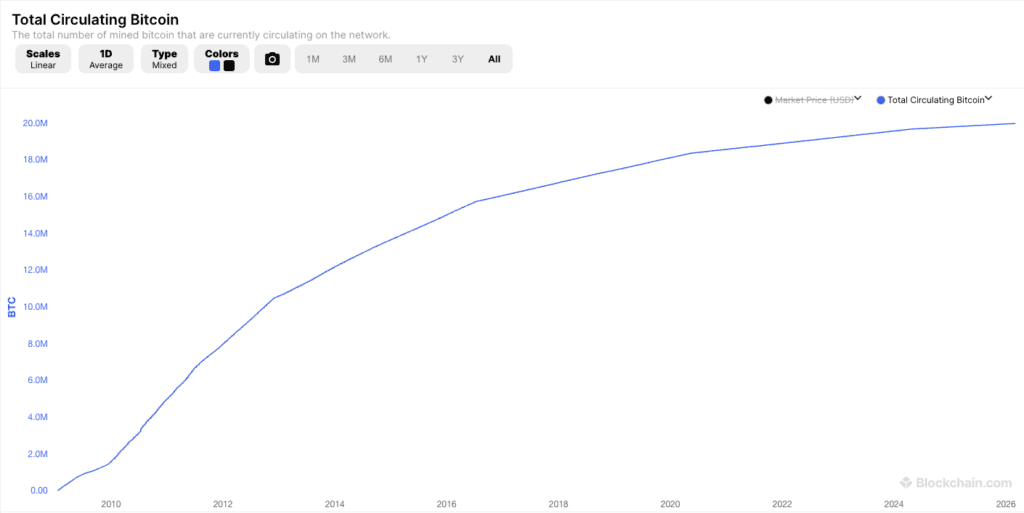
Bitcoin’s maximum supply never changes. The protocol enforces a permanent ceiling of 21 million in numbers, or exactly 21,000,000 BTC.
This number exists permanently. No authority adjusts it. No emergency expands it. Bitcoin simply moves toward it gradually.
This answers the question how many bitcoins are there total. There will never be more than that number.
Traditional currencies expand endlessly. Bitcoin stops.
This difference feels abstract at first. But over time, it becomes central to how investors view Bitcoin. Predictable supply creates predictable scarcity.
Scarcity strengthens perception. Perception strengthens demand.
Bitcoin approaches its limit slowly, block by block.
Difference between circulating supply and total supply
Circulating supply represents bitcoins currently accessible. These coins move between wallets, exchanges, and institutions.
Total supply represents the final limit.
Right now, the circulating supply stands around 19.7 million BTC. Maximum supply remains fixed at 21 million BTC.
This difference represents future issuance.
Traders watch the circulating supply because it determines liquidity. Investors watch the maximum supply because it defines scarcity permanently.
As the circulating supply approaches the maximum, Bitcoin becomes harder to acquire through mining.
Future issuance shrinks.
Read More: Cash Out Bitcoin, Ethereum & More Cryptos: 5 Easy Ways
How many Bitcoins are mined every day (and how much is there left to mine)?
Bitcoin produces blocks continuously. Roughly one every ten minutes. That results in about 144 blocks daily.
Each block produces 3.125 BTC. Multiply that across daily production, and roughly 450 BTC enter circulation each day.
Years ago, this number exceeded 7,000 BTC daily. That flood slowed through repeated halvings.
Only about 1.3 million BTC remain unmined today.
That remaining supply enters circulation slowly. Over decades. Not years.
Traders recognize that fewer new coins entering circulation reduces selling pressure. Investors see the same thing differently. They see increasing scarcity over time.
Each halving tightens supply further.
How many Bitcoins have been lost or stolen?
Not every bitcoin remains accessible. Millions disappeared permanently.
Early users often stored Bitcoin casually. Hard drives failed. Passwords vanished. Wallet files disappeared forever.
At the time, Bitcoin had little financial value. Few imagined its future significance.
Blockchain analysis estimates between 3 million and 4 million BTC remain permanently inaccessible.
These coins still exist technically. Yet nobody controls them.
This significantly reduces the effective circulating supply.
Traders consider this hidden scarcity when evaluating liquidity. Investors recognize that accessible supply remains lower than official numbers suggest.
Lost coins never return.
How many Bitcoins does Satoshi Nakamoto have?
Bitcoin’s creator mined extensively during the network’s earliest period. Blockchain patterns suggest approximately 1 million BTC belong to wallets associated with Satoshi Nakamoto.
These coins remain untouched.
Year after year, those addresses remain silent.
This silence influences perception. Traders monitor those wallets constantly. Investors interpret inactivity as reinforcing Bitcoin’s decentralized structure.
Satoshi’s holdings represent nearly five percent of the total supply.
Yet they remain frozen.
What happens when all 21 million Bitcoins have been mined?
Eventually, Bitcoin reaches its final supply. At that point, the total number of bitcoins in the world stops increasing permanently.
Mining continues. Blocks continue. Transactions continue.
But miners stop receiving newly created Bitcoin.
Instead, miners earn transaction fees.
Supply becomes completely fixed.
Traders anticipate this moment. Investors view it as Bitcoin’s final form.
Scarcity becomes absolute.
When will the final Bitcoin halving be?
Bitcoin halvings occur exactly after 210,000 blocks. The time period is roughly around 4 years. When there is a bitcoin halving, the reward size drops by 50%.
The last Bitcoin halving occurred in 2024, and the next one is due in 2028. Based on this calculation, the last halving will occur in or around 2140.
This is when Bitcoin will reach its permanent supply limit.
Bitcoin supply vs. inflation rate
Bitcoin inflation declines continuously. Early Bitcoin introduced massive supply expansion. Today, expansion remains extremely slow. Future halvings reduce inflation further, and eventually, inflation reaches zero. Bitcoin becomes permanently scarce, which is the core idea behind a lot of Bitcoin investment strategies.
How mining difficulty influences Bitcoin supply timing
Mining difficulty adjusts regularly. This ensures stable block timing. If more miners participate, difficulty rises. If fewer miners participate, difficulty falls. Supply issuance remains predictable. Bitcoin follows its schedule precisely.
Conclusion
Bitcoin operates under absolute supply certainty. The answer to how many bitcoins are in the world remains permanently fixed. Exactly 21 million in numbers will ever exist. Today, nearly all are already in circulation. Only a small portion remains unmined.
Lost coins further reduce the effective supply. Halvings’ slow issuance continues. Eventually, supply expansion stops entirely.
Understanding how many bitcoins are there total explains Bitcoin’s scarcity. Traders monitor issuance to understand liquidity dynamics. Investors focus on long-term supply limits.
Bitcoin stands alone as a financial system governed by mathematical scarcity.
FAQs
1. What happens when all 21 million bitcoins are mined?
Once 21 million BTC are mined, no new Bitcoins will be issued into the market. The creation of new Bitcoins will stop once the 21 million cap is reached.
2. When did Bitcoin first hit $1?
Bitcoin first reached $1 in February 2011. This occurred when the trading activity and public awareness about crypto shot up.
3. How many total bitcoins can exist?
Not more than 21 million Bitcoins. The number of BTC will not surpass this number.
4. Who sold 10,000 Bitcoin for pizza?
Programmer Laszlo Hanyecz is that unfortunate guy! He spent 10,000 BTC on just two pizzas in May 2010! But he became a legend for this very first real-world transaction of Bitcoin.