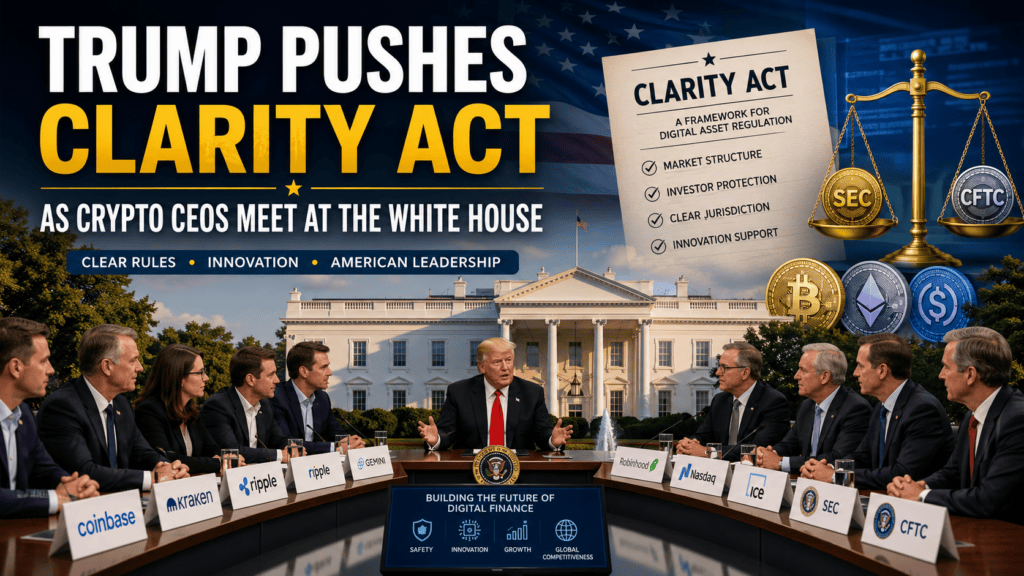
Introduction to the CLARITY Act pushes to Crypto CEOs Meet
The relationship between the U.S. government and the cryptocurrency industry entered another important phase on August 19, 2026, as President Donald Trump hosted major crypto and financial-industry executives at the White House and urged Congress to move forward with the CLARITY Act, a proposed framework for digital-asset regulation.
The meeting brought together senior figures from companies including Coinbase, Kraken, Ripple, Robinhood and major traditional-finance institutions, alongside SEC Chairman Paul Atkins and CFTC Chairman Michael Selig. The gathering came at a crucial moment for the U.S. crypto industry, with lawmakers still debating the legislation and regulators pursuing their own approaches to digital-asset rules.
For the crypto market, the bigger question is no longer whether Washington intends to regulate digital assets. It is how clearly those rules will define the industry’s future.
What Happened at the White House Crypto Summit?
President Trump used the meeting to call on Congress to pass what he described as a fair version of the CLARITY Act.
The proposed legislation is important because the crypto industry has long sought clearer answers to a fundamental question: Which digital assets should be treated as securities, which should fall under commodities rules, and which federal regulator should oversee them?
The meeting also brought industry executives and regulators into the same room, highlighting how closely policy decisions and the digital-asset industry have become connected.
The timing was significant.
The CLARITY Act has stalled in the Senate, with a procedural vote scheduled for September 15. Passing that procedural hurdle would require 60 votes, meaning bipartisan support remains important.
What Is the CLARITY Act?
The CLARITY Act is designed to establish a more comprehensive regulatory framework for digital assets in the United States.
One of the industry’s biggest complaints has been uncertainty over whether a particular cryptocurrency or token should fall under the jurisdiction of the Securities and Exchange Commission (SEC) or the Commodity Futures Trading Commission (CFTC).
That uncertainty can affect:
- Crypto exchanges
- Token issuers
- Blockchain developers
- Stablecoin companies
- DeFi platforms
- Institutional investors
- Market makers
- Financial institutions
A clearer framework could potentially give companies greater confidence about how they can launch products and operate in the U.S. market.
Why Does Regulatory Clarity Matter?
For years, crypto companies have operated in an environment where regulatory interpretation has often been as important as the underlying technology.
A company developing a new token or blockchain application may need to consider whether its activities fall under securities laws, commodities rules, money-transmission requirements or other financial regulations.
The CLARITY Act aims to create clearer boundaries.
That matters because regulatory uncertainty can affect whether companies:
- Launch products in the U.S.
- Raise capital
- List tokens
- Offer trading services
- Build institutional products
- Invest in infrastructure
Greater clarity could potentially reduce some of those uncertainties.
Trump Says the U.S. Should Lead in Crypto
Trump’s message at the summit was broader than simply supporting one piece of legislation.
He positioned cryptocurrency and financial technology as part of America’s broader competition for technological leadership.
The White House gathering included both crypto-native companies and traditional financial institutions, illustrating how digital assets are increasingly becoming part of the mainstream financial conversation.
The underlying message is straightforward:
The U.S. wants crypto businesses to build and innovate domestically rather than move activity to jurisdictions with clearer or more favourable rules.
That could have implications beyond cryptocurrency exchanges.
Read More: What Is the Crypto Clarity Act and How Will It Impact the Crypto Industry?
Crypto CEOs Join Regulators at the White House
The list of participants was notable because it brought together companies operating across different parts of the financial system.
Executives from companies including Coinbase, Kraken, Ripple, Gemini and Robinhood, as well as representatives from Nasdaq and Intercontinental Exchange, participated in discussions alongside senior U.S. regulators.
This is significant because the crypto industry and regulators have historically often been on opposite sides of major policy debates.
Putting both groups in the same room creates a more direct channel for discussing:
- Market structure
- Token classification
- Trading platforms
- Stablecoins
- Institutional adoption
- Prediction markets
- Digital-asset innovation
The meeting therefore represented more than a political event. It showed how deeply digital assets have become integrated into discussions about the future of financial markets.
SEC and CFTC Take Different Roles
The regulatory debate also involves two major U.S. agencies.
The SEC oversees securities markets, while the CFTC regulates commodity and derivatives markets.
One of the central goals of crypto legislation is to provide clearer boundaries between their respective responsibilities.
That distinction matters because the classification of a digital asset can influence the rules that apply to its issuer, exchange or trading activity.
The CFTC is also moving forward with an Innovation Advisory Committee covering topics including crypto-asset regulation, artificial intelligence and prediction markets.
Meanwhile, the SEC has been working on its own regulatory approach to digital assets, including proposals intended to create exemptions and clearer pathways for certain token offerings.
This creates an interesting situation: Congress is working on legislation while regulators are simultaneously developing their own frameworks.
Why the CLARITY Act Has Faced Resistance
Despite support from the Trump administration and much of the crypto industry, the bill has not moved smoothly through Congress.
One major issue is the debate surrounding ethics and potential conflicts of interest involving politicians who have financial exposure to cryptocurrency.
Trump and his family have significant financial interests in crypto-related ventures, something critics have raised during the legislative debate. Trump has defended his position and said his investments are independently managed.
Some lawmakers have therefore pushed for stronger restrictions on political figures profiting from digital assets.
There are also concerns from parts of the traditional financial industry about how the legislation could affect competition between banks and crypto companies.
These political and industry disagreements are among the reasons the legislation remains uncertain.
What Could the CLARITY Act Mean for Crypto Companies?
If enacted in a form broadly supported by the industry, the legislation could provide greater regulatory certainty.
Potential implications include:
Crypto Exchanges
Clearer rules around which regulator oversees particular activities could make compliance and product planning more predictable.
Token Issuers
Companies launching digital tokens could have a clearer understanding of whether and how securities laws apply.
Institutional Investors
Greater regulatory clarity could make digital assets easier for traditional financial institutions to evaluate.
Blockchain Developers
A clearer distinction between software development, token issuance, and regulated financial activity could reduce some uncertainty.
DeFi
Decentralized finance could face particularly important questions around how existing regulatory concepts apply to decentralized protocols and participants.
Could It Accelerate Institutional Crypto Adoption?
Regulatory clarity is one of the factors institutional investors consider when entering emerging asset classes.
Large financial institutions typically need to understand:
- Regulatory responsibilities
- Custody arrangements
- Market structure
- Counterparty risk
- Reporting requirements
- Compliance obligations
A clearer regulatory framework could make it easier for institutions to build products and services around digital assets.
The White House meeting itself reflected this convergence.
The presence of major traditional financial-market institutions alongside crypto companies suggests that the conversation has expanded beyond Bitcoin and retail trading toward the broader financial infrastructure of digital assets.
What Does This Mean for the Crypto Market?
Markets responded positively to the broader regulatory developments surrounding the White House summit.
Bitcoin moved above $68,000 on August 19, while shares of several crypto-related companies also advanced. Coinbase gained about 10%, while Strategy and Circle also posted significant increases during the session.
However, short-term market movements should not be confused with the long-term impact of legislation.
The CLARITY Act still has to navigate Congress.
Until legislation is actually passed and implemented, uncertainty remains.
CLARITY Act vs Regulatory Action
An important distinction is emerging in Washington.
There are essentially two paths toward regulatory clarity:
Congressional legislation
and
Regulatory action by agencies such as the SEC and CFTC.
Legislation can provide a more durable statutory framework, while agency rules and guidance can potentially move faster.
The SEC’s recent proposals and the CFTC’s work on digital assets demonstrate that regulatory change does not necessarily depend entirely on Congress.
However, agency-level changes can also be modified by future administrations, making legislation particularly important for companies seeking long-term certainty.
What Should Crypto Investors Watch Next?
For investors, the most important developments may come over the next several months.
Key events and themes to monitor include:
1. The CLARITY Act Vote
The Senate is expected to consider the legislation after the August recess, with a procedural vote scheduled for September 15.
2. SEC Digital-Asset Rules
New rules and exemptions could influence how token issuers and crypto companies operate.
3. CFTC Crypto Framework
The CFTC’s expanding role could affect derivatives, prediction markets and other digital-asset activities.
4. Stablecoin Regulation
The implementation of the GENIUS Act is another major component of the U.S. digital-asset regulatory framework, with the law expected to take effect in January 2027.
5. Institutional Adoption
Investors should watch whether banks, asset managers, exchanges and financial infrastructure companies expand their digital-asset offerings.
What Could This Mean for the Global Crypto Industry?
The impact of U.S. crypto regulation could extend well beyond American companies.
The United States remains one of the world’s largest financial markets. Rules established there can influence where companies choose to operate, how global institutions structure products and how international investors approach digital assets.
If the U.S. establishes a comprehensive framework, other countries may also face pressure to clarify their own approaches.
For markets such as India, the developments are worth watching because global crypto regulation can influence:
- Institutional participation
- Cross-border digital-asset businesses
- Stablecoin adoption
- Blockchain investment
- Exchange infrastructure
- Tokenization
- Global crypto liquidity
The U.S. regulatory approach is therefore likely to remain relevant even for investors and businesses outside America.
The Bigger Picture
The White House summit represents a significant change in the tone of the U.S. government’s relationship with cryptocurrency.
The discussion is increasingly shifting from:
“Should crypto be regulated?”
to:
“What should the regulatory framework look like, and which agency should oversee what?”
That is an important transition.
The CLARITY Act could become a major milestone if Congress succeeds in establishing clearer rules for the industry. But its future remains uncertain, particularly because of disagreements over ethics provisions, regulatory jurisdiction and the balance between crypto innovation and investor protection.
For now, the White House meeting sends a clear political signal: the Trump administration wants the U.S. to remain a major center for cryptocurrency and digital-asset innovation.
Whether that vision becomes a durable regulatory framework will depend on what happens next in Congress.
Final Thoughts
Trump’s White House meeting with crypto executives marks another important moment in the evolution of U.S. digital-asset policy.
The push for the CLARITY Act comes as crypto companies, regulators and traditional financial institutions increasingly converge around the need for clearer rules.
The outcome remains uncertain. The Senate still needs to work through the legislation, including disagreements surrounding its provisions and political concerns.
But one thing is becoming increasingly clear: crypto regulation in the United States is moving from an enforcement-focused debate toward a broader discussion about building a permanent market structure for digital assets.
For the crypto industry, investors, and financial institutions, what Congress does next could shape the market for years to come.
FAQs
1. What is the CLARITY Act?
The CLARITY Act is proposed U.S. legislation intended to establish a clearer regulatory framework for digital assets and define the respective roles of federal financial regulators.
2. Why did Trump meet crypto CEOs at the White House?
The August 19 meeting brought together crypto executives, traditional financial institutions and U.S. regulators to discuss digital-asset innovation and regulatory policy. Trump also used the meeting to push Congress to advance the CLARITY Act.
3. When could the CLARITY Act be voted on?
A Senate procedural vote is currently scheduled for September 15. A procedural vote would not itself pass the bill and would require 60 votes to overcome the relevant hurdle.
4. Why is regulatory clarity important for crypto?
Clearer rules can help businesses and investors understand how digital assets are classified, which regulator has jurisdiction and what compliance requirements apply.
5. Could the CLARITY Act affect crypto prices?
Regulatory clarity could influence market sentiment and institutional participation, but the passage or failure of legislation does not guarantee a particular price movement. Investors should consider broader market and economic factors as well.