
Two weeks ago, XRP was sitting under a dollar, drifting along the way it had for most of the summer. By last Friday it had touched nearly $1.70, a gain of more than 70% at its peak, before settling back into the high $1.30s — still up around 40% from where it started on August 17. That much is the kind of headline crypto Twitter reposts a hundred times and moves on from.
What actually makes this stretch worth sitting with is a set of numbers that only surfaced this morning, buried in exchange and regulatory data most people never look at: while XRP’s price was rising 40%, the total amount of leveraged betting on it — its futures open interest — actually fell by 16%. And of the leverage that remained, a fast-growing share of it had moved onto CME, the same regulated Chicago exchange where pension funds and asset managers trade oil futures and Treasury bonds, not the offshore platforms that have historically driven crypto’s wildest swings. That’s not the shape of a retail-driven pump.
Treasury doubles long-bond buybacks to $4B/operation; yields fall, dollar weakens.XRP, Aug 17 – Sep 1. Hover or tap the amber points for what moved it. Illustrative trend built from daily levels reported across market-data providers, not tick-level closes.
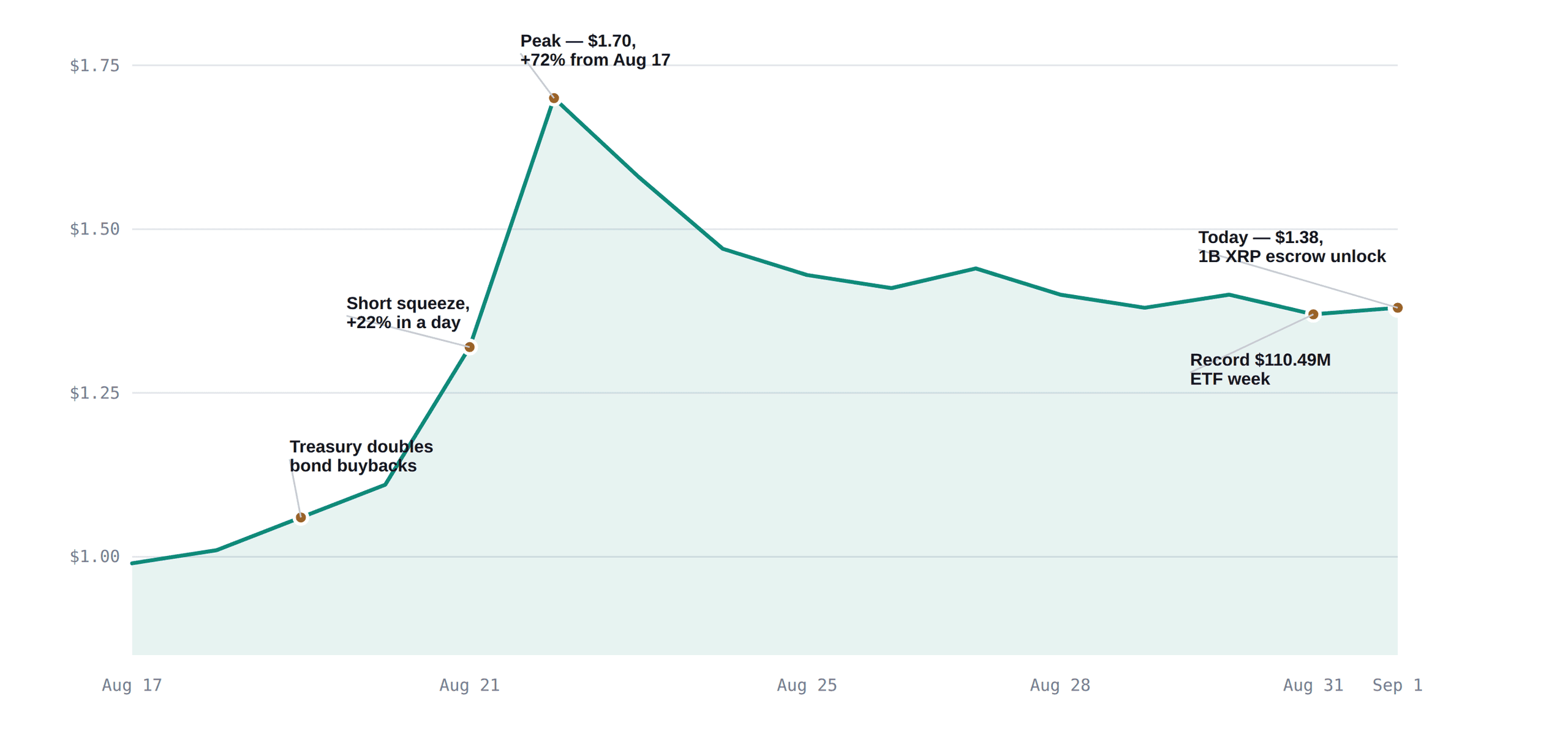
| Date | Price | Event |
|---|---|---|
| Aug 17 | $0.99 | Dormant supply wakes up — 1.1% of XRP moves after 519 days’ average dormancy. |
| Aug 18 | $1.01 | — |
| Aug 19 | $1.06 | Treasury doubles long-bond buybacks to $4B/operation; yields fall, dollar weakens. |
| Aug 20 | $1.11 | — |
| Aug 21 | $1.32 | Short squeeze — XRP jumps ~22% in a day; $1.2B+ in crypto shorts liquidated market-wide. |
| Aug 22 | $1.70 | Peak — up roughly 72% from the Aug 17 low. |
| Aug 23 | $1.58 | — |
| Aug 24 | $1.47 | — |
| Aug 25 | $1.43 | CFTC snapshot: leveraged funds’ net-short position on CME roughly doubles to ~116M XRP. |
| Aug 26 | $1.41 | — |
| Aug 27 | $1.44 | — |
| Aug 28 | $1.40 | — |
| Aug 29 | $1.38 | — |
| Aug 30 | $1.40 | — |
| Aug 31 | $1.37 | XRP ETFs post record $110.49M weekly inflow; CME launches new crypto benchmark indices. |
| Sep 1 | $1.38 | Today — Ripple’s routine 1B XRP escrow unlock; CME futures share now 17%, up from 10%. |
A rally that started with a bond market surprise, not a crypto headline
The spark for XRP’s move didn’t come from anything crypto-specific. On August 19, US Treasury Secretary Scott Bessent announced the government would double the size of its long-bond buyback operations, from $2 billion to at least $4 billion per operation, covering debt maturing in 10 to 30 years and running from September 9 through early November. The move was aimed squarely at the bond market — long-term yields had been climbing uncomfortably, and Bessent wanted to put a floor under prices — but the ripple effects reached well beyond Treasuries.
Long-dated yields fell, the dollar weakened, and a wave of risk-on buying moved through markets that had been coiled and waiting for a reason to move. Bitcoin touched an intraday high above $72,900 within a day of the announcement, and when yields partly rebounded on August 20, Bessent came back the next day and said he was ready to boost the buybacks even further if needed — a level of commitment that told traders this wasn’t a one-off gesture.
XRP was primed for that kind of catalyst in a way few other major tokens were. On-chain data showed something unusual happening on August 17, just before the move started: roughly 1.1% of XRP’s entire circulating supply changed hands in a single day, moved by wallets that had sat untouched for an average of 519 days — about 25 times longer than typical dormancy periods. Whatever that wave of long-term holders knew or sensed, it lined up almost exactly with the Treasury news two days later.
The squeeze that turned a rally into a stampede
What happened next had less to do with new money flooding in and more to do with old bets getting forced out. XRP had built up a meaningful pile of short positions over the summer — traders betting the token would keep drifting sideways or lower — and when the price broke above $1.18 on August 21, those bets started blowing up in a hurry. XRP jumped roughly 22% in that single 24-hour stretch.
Liquidation trackers on one major derivatives venue alone identified nearly $50 million in short positions getting forced closed across a handful of price levels between $1.28 and $1.38, and across the broader crypto market, more than $1.2 billion in short positions were liquidated within 24 hours — with some trackers putting $1.4 billion of that damage inside a single four-hour window. Trading volume on the day spiked past $10 billion, more than double XRP’s typical turnover.
Large holders used the momentum to add roughly 380 million tokens to their positions over that week — even as the price kept climbing toward its $1.70 peak.
None of that is unusual on its own — short squeezes happen in every market, regularly, and most of them fade within days once the forced buying is done. What happened afterward is the part that doesn’t fit the usual script.
The stranger story hiding in the futures data
By the time CME-tracked data through August 31 was compiled, a clear pattern had emerged: total XRP futures open interest across all venues had fallen from roughly 2.77 billion tokens’ worth to 2.34 billion — a 16% drop — even as the price rose 40% over the same stretch. In plain terms, the rally wasn’t being fueled by traders piling on fresh leveraged bets.
If anything, speculative leverage was being pulled out of the market while the price climbed, which typically points to short covering and spot buying doing the heavy lifting rather than a wave of new leveraged longs chasing the move higher. That’s a meaningfully more durable kind of price action than a leverage-driven spike, because there’s less freshly built-up long exposure sitting around waiting to be unwound.
Inside that shrinking pool of leverage, though, one part of the market was growing fast: CME’s own share of total XRP futures open interest climbed from about 10% to 17% over the same two weeks, with CME-held open interest rising 36% — from roughly 284 million to 387 million tokens’ worth — while open interest on offshore and crypto-native platforms fell by about 21%, a decline of roughly 533 million tokens.
Money wasn’t just leaving the futures market broadly; it was leaving offshore venues and consolidating onto the one regulated exchange where institutional risk desks are actually allowed to trade. CME wasn’t standing still while that happened, either — on August 31, the exchange and its benchmark partner CF Benchmarks, regulated by the UK’s Financial Conduct Authority, launched two new crypto indices, one of them built with an eligibility framework already used to construct reference rates for XRP specifically. Neither index settles a derivatives contract today, but the infrastructure being built points toward exactly the kind of asset currently drawing institutional futures flow.
A tug-of-war inside the “smart money” itself
Here’s where the picture gets genuinely more complicated than a simple “institutions are bullish” headline — and worth sitting with rather than smoothing over. Commitment of Traders data from the CFTC, current through August 25, shows that leveraged funds — the CME-registered category that covers hedge funds and other professional speculators — held a net-short position equivalent to about 116 million XRP, roughly double the 57 million XRP net-short position they held just a week earlier. In other words, even as the price rallied hard, the hedge fund crowd was getting more bearish, not less, at least on a net basis.
Professional money isn’t one voice here. Leveraged funds are hedging into the rally while dealers and asset managers lean into it — that split is what a market looks like when serious capital is actively repricing an asset, not agreeing on where it’s headed.
That same CFTC data shows a different story from two other categories of trader. Dealers — banks and market-making desks that typically take the other side of client flow — added about 60 million XRP in net-long exposure over the same window, and asset managers, the category that includes the institutions running ETFs and long-only allocation strategies, added roughly 28 million XRP net-long.
The ETF numbers add one more data point to that side of the ledger: XRP-linked exchange-traded funds pulled in $110.49 million in net inflows for the week ending August 31 — their largest weekly haul since the funds launched, up 177% from the roughly $40 million the week before. Cumulative inflows across the seven US-listed funds have now crossed roughly $1.66 billion, led by Bitwise at over $600 million and Canary Capital at close to $483 million. Only one of the seven funds remains in net outflow.
A billion tokens hit the market today — and almost nobody blinked
Layered on top of all of this is a piece of scheduled, entirely routine housekeeping: today, September 1, Ripple releases its regular monthly unlock of 1 billion XRP from the escrow contracts it set up back in 2017. Headlines built around “Ripple unlocks a billion tokens” tend to sound alarming out of context, but the pattern is well established.
Ripple has historically returned somewhere between 60% and 80% of each monthly unlock straight back into escrow, keeping only what it needs for operational and liquidity purposes. In December 2025, for instance, roughly 70% went back into escrow, leaving somewhere between 300 and 400 million tokens actually liquid. XRP sitting on exchanges — the portion of supply that’s readily sellable — has been trending downward for months as more tokens move into longer-term custody and ETF holdings instead.
How the story traveled — from Treasury desks to Mumbai
International financial press picked up Bessent’s buyback announcement first, treating it as a bond-market and monetary-policy story in its own right — coverage that would have run regardless of what any crypto token did afterward. Crypto-focused trade press picked up the XRP-specific angle within hours of the August 21 squeeze, tracking liquidation totals in real time, and by the end of the month the same outlets were digging into the CME open-interest data and CFTC positioning reports that most price-chasing coverage never touches.
Indian financial media followed a familiar pattern of its own this month: tracking XRP’s move in rupee terms for a domestic audience that has watched the token’s ETF story unfold from a distance, alongside Hindi-language coverage doing the same for readers who follow crypto prices the way they’d follow gold or the sensex. That domestic coverage leaned into the same throughline as the rest of the world’s — a token testing whether a summer of regulatory and institutional groundwork can translate into a rally that holds, rather than one more spike that fades.
What’s confirmed, and what’s still just positioning
Confirmed: the Treasury’s August 19 buyback announcement and Bessent’s follow-up comments are matters of public record; XRP’s move from roughly $0.99 on August 17 to a peak near $1.70 on August 22, and its settling into the $1.37–$1.41 range by month’s end, is reflected consistently across market data providers; the CME open-interest and market-share figures, along with the CFTC’s Commitment of Traders data through August 25, come from the exchange’s and regulator’s own published data; the $110.49 million weekly ETF inflow figure and the individual funds’ cumulative totals are drawn from the funds’ own reported flows; and today’s 1-billion-token escrow unlock is a scheduled, publicly documented event.
Still unconfirmed or forward-looking: how much of today’s unlocked XRP Ripple will actually keep liquid versus return to escrow, which won’t be clear until the transaction settles; whether CME’s growing futures share and the ETF inflow streak continue building or prove to be a two-week snapshot rather than a lasting shift; whether the leveraged funds currently net-short on CME are right, or whether dealers and asset managers leaning long have the better read; and where XRP goes from here technically — one widely followed chart analyst has flagged $1.70 as the next level to watch, with resistance near $1.60, $1.68 and $1.86, but that’s a trader’s read on a chart, not a forecast anyone should treat as settled.
Why this actually matters
It would be easy to file this under “another crypto token had a good couple of weeks” and move on, but the mechanics underneath this particular move are what make it worth understanding rather than just watching the price. A rally accompanied by falling leverage, rather than rising leverage, tends to be a rally with less built-in fragility — there’s simply less forced-selling risk sitting on the table waiting for a reversal to trigger it.
And a market where the growth is concentrated on a regulated, CFTC-overseen exchange rather than offshore platforms is a market that’s becoming easier for large, risk-constrained institutions to actually participate in — precisely the kind of infrastructure shift that tends to matter more over months than over any single week.
The split inside the institutional data — hedge funds hedging while dealers and asset managers add exposure — is a useful reminder that “institutions are buying” is almost never a single, unified story. Professional money disagrees with itself constantly, and that disagreement showing up clearly in the data is a healthier sign than false consensus would be.
What happens next
The most immediate thing to watch is mechanical: how much of today’s 1-billion-token unlock Ripple actually keeps out of escrow, and whether exchange balances tick up or keep drifting down in the days that follow. Beyond that, the CME open-interest and CFTC positioning data will keep updating regularly, and whether that institutional share keeps climbing — or whether this turns out to be a two-week snapshot rather than a trend — is a far more useful thing to track than any single day’s price candle.
The Senate is separately expected to take a procedural vote on broader crypto market-structure legislation in mid-September, which sits in the background of this story without being the reason for it. For now, the more interesting question isn’t where XRP’s price closes on any given day, but whether the kind of trader showing up to trade it keeps looking different than the kind who showed up a month ago.