Introduction of 576 Indians Reported Income of Over ₹100 Crore
India’s pool of ultra-high-income taxpayers has expanded sharply, with 576 Indian individuals reporting a gross total income of ₹100 crore or more in Assessment Year (AY) 2025-26. The figure represents a significant rise from 142 individuals recorded in AY 2021-22, according to data shared by the Ministry of Finance in Parliament.
The latest numbers highlight the rapid growth in the number of Indians reporting exceptionally high annual incomes. However, the data should be interpreted carefully: reporting an annual income of ₹100 crore or more does not necessarily mean that an individual is a billionaire in terms of total wealth or net worth.
576 Indian Individuals Reported ₹100 Crore or More in Income
According to the government data, 576 individuals declared a gross total income of at least ₹100 crore in their income-tax returns for AY 2025-26.
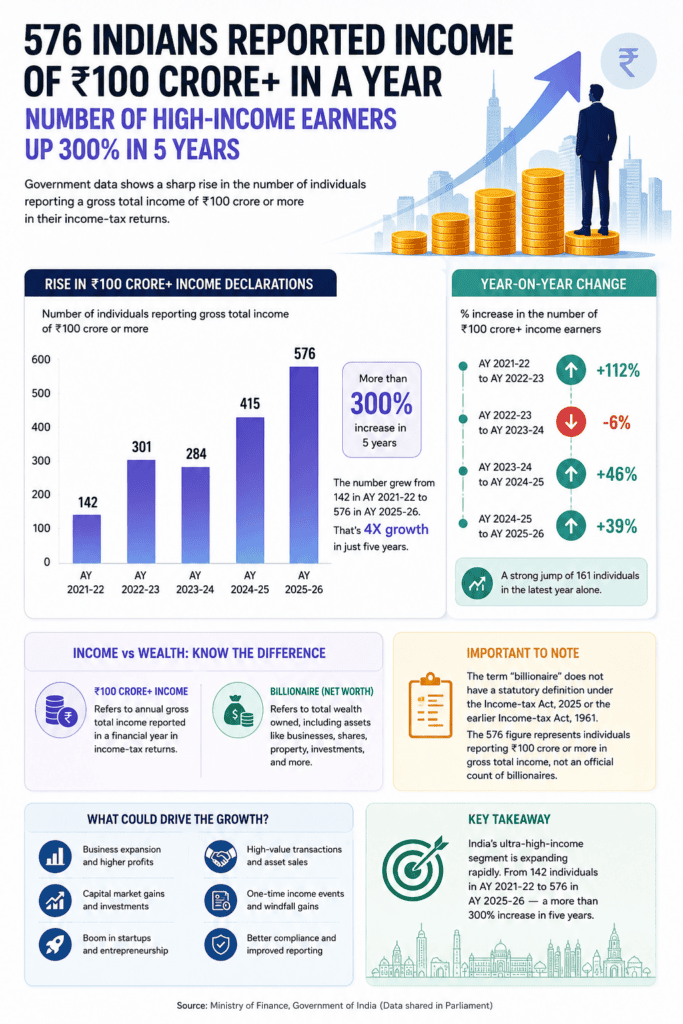
This is a substantial increase from 142 individuals in AY 2021-22. Over the five-year period, the number of people in this income bracket has grown more than four times, translating to an increase of more than 300%.
The year-by-year figures show how this high-income group has evolved:
| Assessment Year | Individuals Reporting ₹100 Crore+ Income |
|---|---|
| AY 2021-22 | 142 |
| AY 2022-23 | 301 |
| AY 2023-24 | 284 |
| AY 2024-25 | 415 |
| AY 2025-26 | 576 |
The latest year also recorded a notable jump. The number increased by 161 individuals from 415 in AY 2024-25 to 576 in AY 2025-26, representing a rise of nearly 39% in a single year.
Why the 300% Increase Matters
The expansion of the ₹100 crore-plus income category offers an interesting view of India’s changing high-income landscape.
Several factors could contribute to such a rise. Strong business performance, entrepreneurship, growth in financial markets, high-value asset sales, executive compensation and other large taxable income events can all influence the number of individuals reporting exceptionally high incomes in a particular assessment year.
It is also important to remember that income reported in a tax return can vary considerably from year to year. A person may report a very high income in one year because of a major business transaction, capital gains or another one-time event. Therefore, the figures should not automatically be interpreted as a permanent increase in annual earnings for every individual in the group.
The “Billionaire” Label Needs Some Context
The recent data has been widely discussed in the context of India’s growing billionaire population. However, there is a crucial difference between income and wealth.
An individual reporting ₹100 crore or more as gross total income in an income-tax return is not necessarily a billionaire in terms of net worth. A person’s wealth includes assets such as shares, businesses, property and other investments, while annual income represents earnings or taxable receipts during a particular period.
The Ministry of Finance has also clarified that the term “billionaire” does not have a statutory definition under either the Income-tax Act, 2025 or the earlier Income-tax Act, 1961. Therefore, the 576 figure should be understood specifically as the number of individuals reporting gross total income of ₹100 crore or more, rather than as an official count of India’s dollar billionaires.
A Sign of India’s Expanding High-Income Economy?
The rise in the number of ₹100 crore-plus income declarations comes against the backdrop of India’s expanding economy and growing entrepreneurial ecosystem.
Over the past few years, India has witnessed the emergence of new businesses, technology companies, financial ventures and consumer brands. At the same time, established companies have expanded into larger markets, while India’s capital markets have created opportunities for wealth creation.
These trends can potentially contribute to a larger pool of high-income individuals. However, the tax-return data alone cannot establish exactly which sectors or professions are responsible for the increase.
The data also does not provide a complete picture of India’s overall wealth distribution. It captures individuals who reported the specified level of gross total income in their income-tax returns, not the total wealth owned by all Indians.
What Does the Data Tell Us About India’s Wealth Story?
The increase from 142 individuals in AY 2021-22 to 576 in AY 2025-26 is certainly notable. It suggests that the number of people reporting exceptionally high annual incomes has expanded considerably.
At the same time, the development raises broader questions about income distribution and economic inclusion. A growing number of high-income individuals can reflect greater wealth creation and economic opportunity, but it does not by itself indicate how widely the benefits of economic growth are being distributed.
For policymakers, the challenge is to encourage entrepreneurship, investment and wealth creation while ensuring that economic growth also translates into better opportunities and improved living standards across a broader section of society.
What Could Drive the Growth in High-Income Taxpayers?
There is no single explanation for the increase in ₹100 crore-plus income declarations. Possible contributing factors include:
- Business expansion: Successful entrepreneurs and business owners may see higher taxable income as their companies grow.
- Capital market gains: Strong market performance and the sale of investments can lead to significant taxable income in a given year.
- Startup ecosystem: Founders and early investors may realise substantial gains during funding events, acquisitions or share sales.
- High-value transactions: One-time asset sales or other financial events can significantly increase income reported in a particular year.
- Improved tax compliance: Greater digitisation and data-driven tax administration may encourage more accurate income reporting.
These factors may operate together, and the available government data does not establish the contribution of each factor individually.
India’s Ultra-High-Income Segment Is Getting Larger
The jump to 576 individuals reporting ₹100 crore or more in gross total income marks a significant change from the 142 recorded five years earlier.
The trend points to a growing segment of Indians operating at the very top end of the income spectrum. But the numbers also underline why it is important to distinguish between income, wealth and net worth when discussing India’s rich and ultra-rich population.
As India continues to expand its economy, deepen its financial markets and develop its startup ecosystem, the size and composition of its high-income population could continue to evolve.
For now, the latest tax data provides one clear takeaway: the number of individuals reporting exceptionally high annual incomes in India has increased sharply, with 576 people declaring gross total income of ₹100 crore or more in AY 2025-26—more than four times the number recorded five years earlier.
FAQs
1. How many Indians reported income above ₹100 crore?
A total of 576 individuals reported gross total income of ₹100 crore or more in their income-tax returns for AY 2025-26.
2. How much has the number of ₹100 crore-plus income earners increased?
The number rose from 142 in AY 2021-22 to 576 in AY 2025-26, representing a more than four-fold increase and a rise of over 300%.
3. Does earning ₹100 crore make someone a billionaire?
Not necessarily. ₹100 crore refers to annual income, while billionaire status generally refers to a person’s total net worth. The government has also clarified that “billionaire” has no statutory definition under India’s Income-tax Acts.
4. Why has the number of high-income individuals increased?
Possible factors include business growth, capital market gains, entrepreneurship, high-value financial transactions and improved income reporting. The government data does not identify one specific reason for the increase.