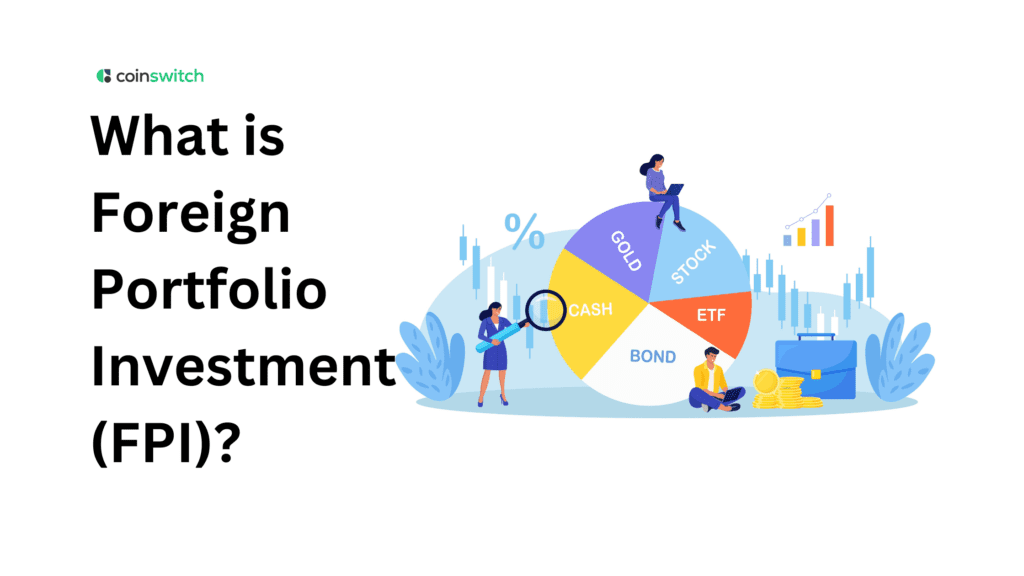
Foreign Portfolio Investment (FPI) refers to investments made by foreign individuals, institutions, or funds in a country’s financial assets such as stocks, bonds, mutual funds, and exchange-traded funds (ETFs). Unlike Foreign Direct Investment (FDI), where investors acquire a significant ownership stake and management control in a company, FPI investors typically seek financial returns without actively participating in business operations.
Read more: Economic Survey Insights
In India, Foreign Portfolio Investment plays a crucial role in the capital markets by increasing liquidity, improving price discovery, and attracting global capital into the economy.
Understanding Foreign Portfolio Investment
When foreign investors purchase shares of Indian companies listed on stock exchanges or invest in government and corporate bonds, these investments are categorized as Foreign Portfolio Investments.
FPIs generally include:
- Foreign Institutional Investors (FIIs)
- Sovereign Wealth Funds
- Pension Funds
- Mutual Funds
- Hedge Funds
- Insurance Companies
- Asset Management Companies
These investors allocate capital across various markets based on economic growth prospects, interest rates, market valuations, and geopolitical conditions.
How Does Foreign Portfolio Investment Work?
Foreign investors register with market regulators and invest in financial instruments through approved channels.
The process typically involves:
- Registration with regulatory authorities.
- Opening trading and custodian accounts.
- Investing in eligible securities.
- Monitoring and managing the portfolio.
- Buying or selling assets based on market conditions.
In India, FPIs are regulated by the Securities and Exchange Board of India (SEBI) and must comply with prescribed investment norms.
Types of Foreign Portfolio Investments
Equity Investments
Foreign investors purchase shares of publicly listed companies to benefit from potential capital appreciation and dividends.
Debt Investments
FPIs invest in government securities, corporate bonds, treasury bills, and other fixed-income instruments to earn interest income.
Hybrid Instruments
These investments combine features of both equity and debt, offering diversified risk-return profiles.
Exchange-Traded Funds (ETFs)
Foreign investors can gain exposure to Indian markets through ETFs that track specific indices or sectors.
Key Features of FPI
Easy Entry and Exit
Unlike FDI, portfolio investments can generally be bought and sold relatively quickly.
No Management Control
FPI investors typically do not participate in the management of the companies they invest in.
High Liquidity
Most portfolio investments can be traded on stock exchanges, making them highly liquid.
Diversification
Investors can spread risk across multiple sectors, companies, and asset classes.
Market-Driven Returns
Returns depend on market performance, interest rates, and economic conditions.
Benefits of Foreign Portfolio Investment
Increased Market Liquidity
FPI inflows bring additional capital into financial markets, improving trading activity.
Economic Growth
Foreign investments can support economic development by providing capital to businesses and governments.
Improved Market Efficiency
Global investors contribute to better price discovery and market transparency.
Broader Investor Base
FPI attracts international participation, making markets more competitive and dynamic.
Currency Support
Large foreign capital inflows can strengthen a country’s foreign exchange reserves and support its currency.
Risks Associated with FPI
Market Volatility
Foreign investors may quickly withdraw capital during periods of uncertainty, causing market fluctuations.
Currency Risk
Exchange rate movements can impact investment returns for foreign investors.
Global Economic Factors
Interest rate changes, geopolitical events, and economic slowdowns can influence FPI flows.
Liquidity Risk
In stressed market conditions, liquidity may decline, affecting investment exits.
Difference Between FPI and FDI
| Basis | FPI | FDI |
| Purpose | Financial returns | Long-term business ownership |
| Ownership | Small stake | Significant ownership |
| Management Control | No | Yes |
| Investment Horizon | Short to medium term | Long term |
| Liquidity | High | Relatively low |
| Impact on Business | Limited | Direct operational involvement |
Why Is FPI Important for India?
India remains one of the most attractive emerging markets for global investors due to:
- Strong economic growth prospects
- Large consumer market
- Expanding digital economy
- Growing corporate earnings
- Diverse investment opportunities
Foreign Portfolio Investment helps deepen India’s capital markets and supports the country’s integration into the global financial system.
Factors That Influence FPI Flows
Several factors determine whether foreign investors increase or decrease investments in India:
Interest Rates
Higher interest rates can attract foreign capital seeking better returns.
Economic Growth
Strong GDP growth often encourages foreign investment.
Inflation
Lower inflation generally improves investor confidence.
Political Stability
Stable governance and predictable policies attract global investors.
Currency Movements
A stable currency can make investments more attractive to foreign investors.
Global Market Conditions
International risk sentiment often affects capital flows across emerging markets.
Conclusion
Foreign Portfolio Investment (FPI) is a significant source of capital for financial markets and plays a vital role in economic development. By investing in stocks, bonds, and other securities, foreign investors contribute to market liquidity, price discovery, and capital formation. While FPI brings several benefits, it can also introduce volatility due to changing global market conditions. Understanding how FPI works can help investors better interpret market movements and the factors driving capital flows into and out of India.
FAQs
What is Foreign Portfolio Investment (FPI)?
Foreign Portfolio Investment (FPI) refers to investments made by foreign investors in a country’s financial assets such as stocks, bonds, mutual funds, and ETFs without obtaining management control.
What is the difference between FPI and FDI?
FPI involves investing in financial securities for returns, whereas FDI involves acquiring a significant ownership stake and participating in business operations.
Why is FPI important for India?
FPI increases market liquidity, attracts foreign capital, supports economic growth, and improves market efficiency.
Who can invest as an FPI in India?
Foreign institutional investors, pension funds, sovereign wealth funds, mutual funds, insurance companies, and other eligible foreign entities can invest as FPIs.
How does FPI affect the stock market?
Large FPI inflows generally support stock prices and liquidity, while significant outflows can create market volatility and downward pressure on stock prices.