Introduction of Gold Price Predictions & Forecasts
Gold has entered a period of unusually strong prices, raising an important question for investors and buyers: where could gold prices go next?
Forecasting gold prices several years into the future is inherently uncertain. No analyst or model can reliably predict the exact price of gold in 2030, 2040 or 2050. Instead, long-term forecasts are better understood as scenario estimates based on factors such as inflation, interest rates, central-bank purchases, currency movements, geopolitical risk and investment demand.
This article explores possible gold price scenarios for 2026, 2030, 2040 and 2050, with a focus on India and prices per 10 grams.
Important: The long-term figures in this article are illustrative scenarios, not guaranteed price targets or investment advice.
Gold Price Today: 2026 Starting Point
Gold prices have risen significantly in 2026. The current market provides an important starting point for considering where prices could go over the coming years.
For Indian investors, the domestic price of gold is influenced not only by international gold prices but also by the movement of the Indian rupee against the US dollar, import costs, taxes and local market conditions.
This means that Indian gold prices can behave differently from international gold prices.
Read More: Best Gold ETFs in India 2026: Top Picks for SIP and Long-Term Investment
Gold Price Prediction for 2026
The outlook for gold in the remainder of 2026 remains closely linked to interest rates, geopolitical developments, central-bank demand and investment flows.
At the same time, elevated prices could affect jewellery demand as consumers become more sensitive to the cost of buying gold.
Illustrative 2026 Scenario
| Scenario | Gold Price per 10g |
|---|---|
| Lower scenario | ₹1.60 lakh |
| Base scenario | ₹1.75 lakh |
| Higher scenario | ₹1.90 lakh |
These figures are scenario estimates, rather than predictions of the exact year-end price.
The actual price could move considerably in either direction depending on interest rates, inflation, the US dollar, geopolitical developments and investor sentiment.
Why Could Gold Continue Rising?
Several structural factors could support gold over the longer term.
1. Central Bank Buying
Central banks have become important participants in the global gold market.
Countries may increase gold reserves as part of their broader strategy to diversify foreign-exchange reserves and reduce dependence on individual currencies or other assets.
Continued central-bank demand could provide an important source of support for gold prices.
2. Geopolitical Uncertainty
Gold is traditionally viewed as a safe-haven asset during periods of economic and geopolitical uncertainty.
Wars, trade tensions, political instability and concerns about the global economy can increase demand for assets perceived as stores of value.
3. Interest Rates
Gold does not generate interest income.
Therefore, changes in interest rates can affect its relative attractiveness compared with interest-bearing investments.
Lower interest rates can potentially support gold demand, while persistently high real interest rates can put pressure on gold prices.
4. Inflation
Gold is often considered a store of value during periods of inflation.
However, inflation alone does not determine gold prices. Interest rates, currency movements, investor demand and economic conditions also play important roles.
5. Indian Rupee Movement
For Indian investors, the exchange rate is particularly important.
If the Indian rupee weakens against the US dollar, international gold prices can translate into higher domestic prices even when the dollar-denominated gold price does not change significantly.
Gold Price Prediction for 2030
Looking toward 2030 introduces considerably more uncertainty.
Rather than claiming that gold will reach a particular price, it is more useful to consider different scenarios.
An illustrative range for 2030 could look like this:
| 2030 Scenario | Gold Price per 10g |
|---|---|
| Lower scenario | ₹2.00 lakh |
| Base scenario | ₹2.25 lakh |
| Higher scenario | ₹2.60 lakh |
The base scenario is an illustrative long-term estimate, not a consensus analyst target.
Continued inflation, central-bank accumulation, investment demand and a weaker rupee could support higher domestic gold prices.
On the other hand, stronger economic growth, higher real interest rates, a stronger rupee and reduced geopolitical risk could limit gold’s gains.
Gold Price Prediction for 2040
Forecasting gold prices to 2040 is significantly more uncertain because economic conditions, currencies, monetary policies and global demand could look very different from today.
An illustrative scenario could be:
| 2040 Scenario | Gold Price per 10g |
|---|---|
| Lower scenario | ₹3.20 lakh |
| Base scenario | ₹3.90 lakh |
| Higher scenario | ₹4.80 lakh |
These numbers should not be interpreted as guaranteed future prices.
The purpose of a long-term scenario is to demonstrate how different assumptions about gold’s growth could translate into potential future prices.
Read More: Why Indian Households Are Selling Old Gold Jewellery as Gold Prices Fall
Gold Price Prediction for 2050
A 2050 forecast should be treated with even greater caution.
More than two decades is an extremely long period for a financial asset. Changes in technology, monetary systems, inflation, global trade, central-bank reserves and investment behaviour could all materially change gold’s role in the global economy.
For illustration:
| 2050 Scenario | Gold Price per 10g |
|---|---|
| Lower scenario | ₹5.00 lakh |
| Base scenario | ₹6.50 lakh |
| Higher scenario | ₹8.50 lakh |
The range is intentionally wide because uncertainty increases substantially with the forecast horizon.
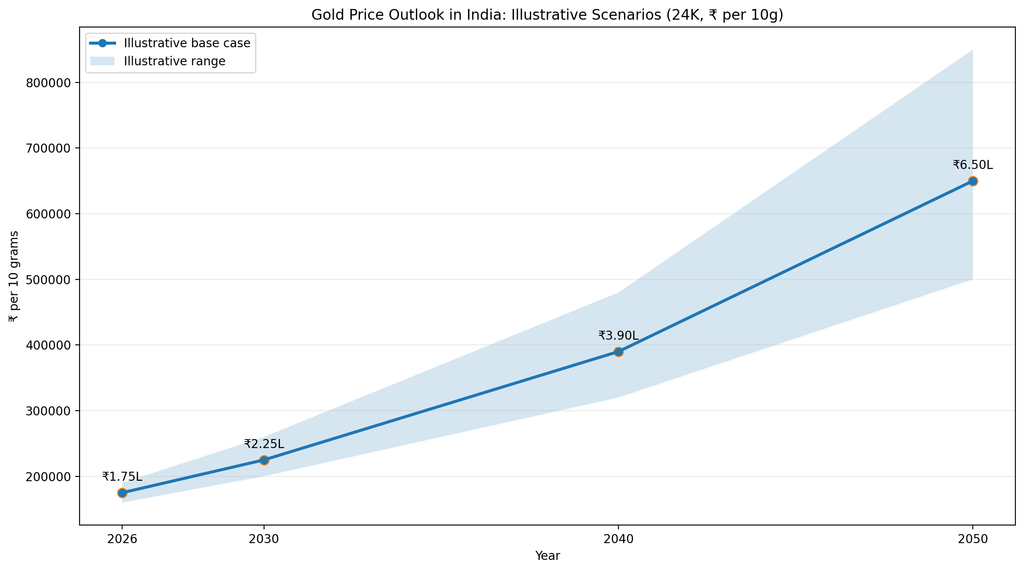
Gold Price Forecast: 2026–2050
| Year | Lower Scenario | Base Scenario | Higher Scenario |
|---|---|---|---|
| 2026 | ₹1.60 lakh | ₹1.75 lakh | ₹1.90 lakh |
| 2030 | ₹2.00 lakh | ₹2.25 lakh | ₹2.60 lakh |
| 2040 | ₹3.20 lakh | ₹3.90 lakh | ₹4.80 lakh |
| 2050 | ₹5.00 lakh | ₹6.50 lakh | ₹8.50 lakh |
All figures are illustrative estimates for 24K gold per 10 grams in India. They are not guaranteed prices or investment targets.
Gold Price Forecast Graph
Use the generated graph showing the lower, base and higher scenarios from 2026 to 2050 here.
What Could Make Gold Prices Go Higher?
Several factors could push gold above the base scenario.
Strong Central Bank Demand
If central banks continue increasing their gold reserves, demand could remain structurally strong.
Lower Global Interest Rates
Falling interest rates could increase the relative attractiveness of non-yielding assets such as gold.
Persistent Geopolitical Risk
Extended geopolitical conflicts or increased economic uncertainty could encourage investors and governments to increase exposure to gold.
Higher Inflation
A prolonged period of elevated inflation could increase demand for assets perceived as stores of value.
Rupee Depreciation
A weaker Indian rupee could increase domestic gold prices even if international gold prices rise more moderately.
What Could Make Gold Prices Fall?
Gold is not guaranteed to rise indefinitely.
Several developments could create downward pressure.
Higher Real Interest Rates
If interest rates remain high relative to inflation, investors may prefer interest-bearing assets over gold.
Stronger US Dollar
A stronger dollar can make gold more expensive for buyers using other currencies and potentially put pressure on international gold prices.
Lower Geopolitical Risk
If geopolitical tensions decline significantly, some safe-haven demand could disappear.
Reduced Central Bank Purchases
A substantial slowdown in official-sector gold purchases could weaken one of the market’s important sources of demand.
Increased Gold Supply
Higher mine production or increased recycling could add supply to the market, although gold supply generally responds relatively slowly to price changes.
Is Gold a Good Investment for the Long Term?
Gold can play different roles in an investment portfolio.
Some investors use it as:
- A diversification asset
- An inflation hedge
- A store of value
- A safe-haven asset
- A way to reduce portfolio concentration
But gold also has limitations.
Unlike a business or bond, physical gold does not generate regular cash flow or interest. Its return depends primarily on changes in its market price.
Investors should therefore consider gold as part of their overall asset allocation rather than assuming that historical performance guarantees future returns.
Gold vs Inflation: Does Gold Always Beat Inflation?
Not necessarily.
Gold can perform strongly during certain inflationary periods, but its price is also affected by:
- Interest rates
- Currency movements
- Economic growth
- Investor sentiment
- Central-bank activity
- Geopolitical developments
- Jewellery demand
- Investment demand
Therefore, gold should not be treated as a guaranteed inflation hedge over every time period.
Gold Price in India vs International Gold Price
Indian gold prices do not move exactly in line with international gold prices.
The domestic price is influenced by:
International gold price + USD/INR exchange rate + import-related costs + taxes + local market factors
This is why Indian investors can sometimes see gold prices rise even when the international move is relatively modest.
Jewellery prices can differ even further because they may include:
- Making charges
- GST
- Retail margins
- Design charges
- Wastage charges
As a result, the price quoted by a jewellery store may not be directly comparable with a wholesale or benchmark bullion price.
Should You Buy Gold in 2026?
There is no universal answer.
Someone buying jewellery for a near-term event has a different objective from an investor building a long-term portfolio.
Before buying gold, investors should consider:
- Investment horizon
- Purpose of buying
- Risk tolerance
- Current gold allocation
- Physical vs digital gold exposure
- Transaction costs
- Liquidity requirements
Most importantly, investors should avoid making decisions solely because a forecast says gold could reach a particular price in the future.
Gold Price Prediction: Key Takeaways
Gold’s long-term outlook remains influenced by several structural forces.
- Gold prices are trading at elevated levels in 2026.
- Central banks remain important participants in the gold market.
- Investment demand can influence prices significantly.
- Geopolitical uncertainty can increase safe-haven demand.
- Interest rates and the US dollar remain important short- and medium-term drivers.
- The Indian rupee can significantly affect domestic gold prices.
- Long-term forecasts for 2040 and 2050 are inherently uncertain.
- Scenario ranges are more useful than claiming a precise future gold price.
Final Thoughts
Gold’s recent performance has once again put the precious metal at the centre of investor attention.
The case for higher gold prices rests on factors such as central-bank demand, geopolitical uncertainty, investment flows and potential changes in interest rates. At the same time, high valuations, stronger real yields or a sustained reduction in global risk could create periods of correction.
For that reason, a range of scenarios is more useful than a single number.
The 2026 estimate can be updated as market conditions change, while the 2030, 2040 and 2050 scenarios should be viewed primarily as long-term illustrations of how gold prices might evolve under different conditions.
FAQs
1. What will be the gold price in 2026?
There is no guaranteed year-end price. Based on the illustrative scenarios in this article, 24K gold could be around ₹1.60 lakh–₹1.90 lakh per 10 grams, with ₹1.75 lakh used as the base scenario. Actual prices can differ significantly.
2. What could gold be worth in 2030?
Our illustrative scenarios put 24K gold at ₹2.00 lakh–₹2.60 lakh per 10 grams in 2030, with ₹2.25 lakh as the base scenario. This is not a guaranteed or official forecast.
3. What could gold be worth in 2040?
A wide range is appropriate for such a distant forecast. Our illustrative range is ₹3.20 lakh–₹4.80 lakh per 10 grams, with a ₹3.90 lakh base scenario.
4. What could gold be worth in 2050?
Because 2050 is more than two decades away, precise forecasting is highly uncertain. An illustrative range is ₹5 lakh–₹8.5 lakh per 10 grams.
5. Will gold prices always increase?
No. Gold can experience significant corrections and periods of stagnation. Interest rates, the US dollar, economic growth, geopolitical conditions and investor demand can all cause prices to move lower.
6. Is this gold price forecast guaranteed?
No. The 2030, 2040 and 2050 figures in this article are illustrative scenarios, not guaranteed prices, investment advice or official forecasts.