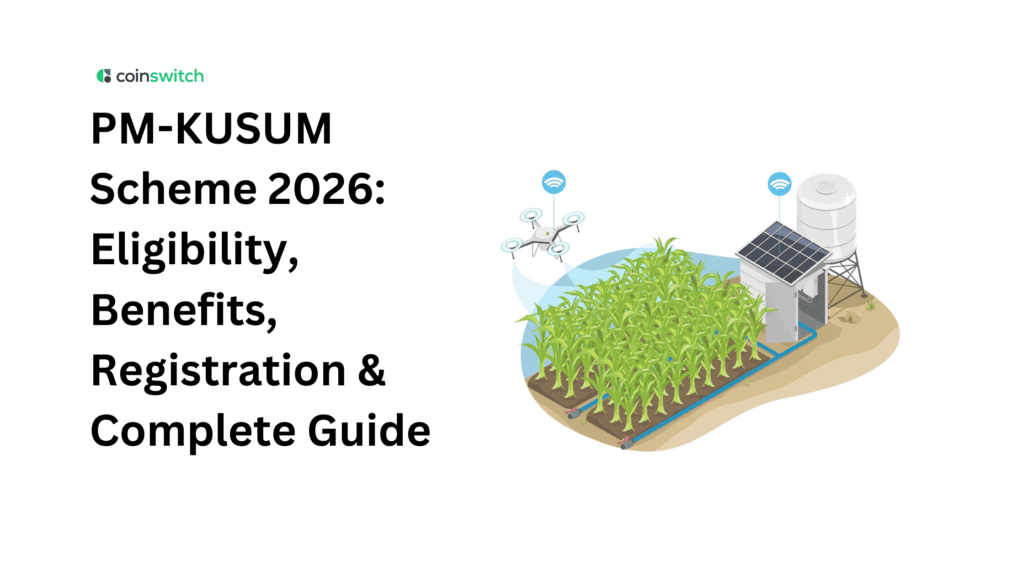
Farming in India has always been a brutal gamble against two things: unpredictable weather and broken rural electricity grids. For decades, keeping crops alive meant either burning a fortune on expensive diesel engines or destroying your sleep schedule to sprint to the fields at 2 AM because the local utility finally decided to flip the agricultural power lines on for a few hours. The PM-KUSUM scheme completely shatters this frustrating cycle. Backed by massive government funding, this initiative stops treating farmers like helpless energy consumers.
Read more: Solar Water Heater Subsidy 2026: Eligibility, Benefits, Registration & Complete Guide
What is the Scheme/Subsidy?
The Pradhan Mantri Kisan Urja Suraksha evam Utthaan Mahabhiyan (PM-KUSUM) is a massive agricultural solarization drive run straight out of the Ministry of New and Renewable Energy (MNRE). The logic is simple: the government hands out heavy capital subsidies covering up to 60% of total system costs so you can throw out your high-maintenance diesel pumps, mount standalone solar water pumps, or build small grid-connected solar generation arrays right on your own land.
Latest Updates (2026)
The ground rules and financial outlays have shifted significantly heading into the current 2026 fiscal cycle. First, the MNRE officially extended the Phase 1 project completion deadline to March 31, 2027, specifically protecting active projects where Power Purchase Agreements (PPAs) were signed by late 2025 so conservative banks would finally release stuck credit lines. Second, the Union Budget stepped up funding allocations aggressively, locking down a massive ₹5,000 Crore wallet for the agricultural solarization pool to build out the upcoming PM-KUSUM 2.0 framework.
Objectives
The entire framework operates on three hard targets. It aims to systematically wipe out toxic, high-maintenance diesel irrigation machinery from agricultural fields. It focuses on handing farmers guaranteed access to maximum water pressure during secure, predictable daylight hours. Finally, it turns barren, uncultivable dirt into an active monthly income stream by letting farmers generate solar electricity and sell the excess capacity back to local utilities.
Key Benefits
The practical payoffs hit your balance sheet immediately. It completely zeroes out your recurring monthly fuel purchases and drops your old electric bills down to absolute zero. You gain complete daytime operational freedom since there is no more staggering through dark fields in the middle of the night—you irrigate when the sun is up. By raising the panels high on structural stilts, a setup known as agrivoltaics, you can harvest crops on the soil below while generating solar energy directly above them.
Subsidy Amount
The financial breakdown under the popular Component B (Standalone Off-Grid Pumps) divides the project cost seamlessly:
| Funding Source | Standard Regions | Hilly, Border & Island Regions* |
|---|---|---|
| Central Government Subsidy | 30% of benchmark cost | 50% of benchmark cost |
| State Government Subsidy | 30% of benchmark cost | 30% of benchmark cost |
| Bank Loan Facility | Up to 30% of cost | Up to 10% of cost |
| Upfront Farmer Contribution | Just 10% of total cost | Just 10% of total cost |
Eligibility Criteria
You can actively apply for these solar allocations if you fit into these brackets:
- Individual farmers owning clear, undisputed agricultural land titles with an active open well or borewell water source.
- Registered Farmer Producer Organizations (FPOs) and rural agricultural cooperatives.
- Local Panchayats and functional Water User Associations (WUAs).
- Private solar developers who have executed legally binding land-lease agreements with local rural landowners.
Who Cannot Apply?
- Applicants with messy, unverified land records or missing ancestral mutation papers.
- Farmers who have already pocketed solar pump subsidies from alternative central or state government agricultural schemes.
- For off-grid standalone systems (Component B), individuals who already possess a functional, regular grid-connected agricultural electricity line are pushed to the back of the line.
Documents Required
Get these core parameters scanned cleanly before opening the portal:
- Identity Metrics: Aadhaar Card, Voter ID, and linked PAN Card.
- Land Verification: Latest digital Khasra-Khatauni records, 7/12 extract, or Jamabandi papers.
- Water Source Validation: Proof of an active borewell, farm pond, or local river lifting permission.
- Financial Assets: Bank passbook front page or a canceled check leaf tied directly to your Aadhaar-linked account.
How to Apply Online
The operational framework runs straight through individual state renewable portals:
- Head directly to your specific state’s nodal site (like MEDA for Maharashtra or RRECL for Rajasthan).
- Click the active “PM-KUSUM Solar Pump Application” tab and sign up using your Aadhaar-linked mobile number.
- Fill out your exact land specs and choose your required pump capability (3 HP, 5 HP, or 7.5 HP).
- Upload your clear document scans and hit submit.
- Pay the minor token registration fee directly via the integrated secure payment gateway.
Offline Application Process
If dealing with digital forms sounds like a headache, you can do it physically:
- Walk straight into your local District Agriculture Office or the nearest authorized Common Service Center (CSC).
- Grab the physical PM-KUSUM layout form matching your target component.
- Manually fill out the details and staple self-attested copies of your Aadhaar, bank records, and land maps.
- Hand the binder directly to the resident Agricultural Extension Officer.
- Do not leave without a physical, stamped acknowledgment receipt containing your application ID.
Application Fees
The entry filing fee is highly nominal, generally ranging from ₹250 to ₹5,000, heavily dependent on the specific component and the pump horsepower capacity you select.
Absolute Safety Warning: A massive wave of fake clone domains (.org, .in.net) are actively trying to scam farmers by demanding heavy upfront registration fees. The ministry will never ask for large lump sums via WhatsApp or unofficial URLs. Always ensure you are on an official state nodal site or pmkusum.mnre.gov.in.
Processing Timeline
Once your upfront baseline token payment clears the system, the internal state audit takes roughly 30 to 45 days to clear your files and issue an official sanction letter. After that, the state-empaneled solar vendor handles the physical transportation, structure mounting, and final net-metering setup within 60 to 90 days.
How to Check Status
- Log back into your state’s designated renewable energy nodal application dashboard.
- Click the prominent tracking button labeled “Beneficiary Application Tracking.”
- Punch in your unique application reference ID or your registered Aadhaar number.
- The tracking engine will instantly reveal exactly where your file is stuck—whether it’s at document audit, vendor allocation, or physical site inspection.
State-wise Benefits
- Rajasthan: The absolute king of Component B standalone off-grid pumps, successfully transforming vast desert tracts into daytime farming zones.
- Maharashtra: Focuses aggressively on Component C feeder-level solarization, actively shifting entire rural sub-stations off the main coal grid onto dedicated agricultural solar loops.
- The Hilly Belts: States like Uttarakhand and Himachal capture the enhanced 50% central financing pool, drastically dropping the cash barriers for remote mountain communities.
Participating Banks/Departments
Major national lenders like State Bank of India (SBI), Union Bank of India, and regional rural cooperative banks offer structured agricultural term credit lines. These loans feature comfortable 12 to 15-year repayment timelines, specifically structured so that the EMI is paid off by the direct cash savings you make from dropping diesel completely.
Common Reasons for Rejection
- Tiny spelling differences between the name on your Aadhaar card and the historical text in your official land registries.
- Failing to prove you have a live, operational water supply ready on the target installation plot.
- Land parcels caught in active inheritance court battles or lacking a clean non-encumbrance profile.
Tips to Improve Approval Chances
- Make absolutely sure your active mobile number is smoothly linked to your Aadhaar for biometric OTP verifications.
- Pull a fresh, digitally signed land record copy from your state’s online portal instead of using blurry, decade-old physical paperwork.
- Stick to standard pump sizes (like 5 HP) that match your actual water depth and land size according to the official MNRE calculator metrics.
Latest Government Updates
The administration is actively cracking down on execution delays. The government is penalizing empaneled solar vendors who take deposits and stall installations. Additionally, new smart controllers feature remote monitoring chips, allowing state utilities to track generation metrics in real-time, paving the way for automated carbon credit payouts directly to your account.
Conclusion
The PM-KUSUM scheme is a highly practical blueprint for achieving complete energy independence on the farm. By eliminating volatile monthly fuel bills and replacing a dead grid with reliable daytime power, the initiative secures sustainable agricultural income across India. Don’t leave your livelihood exposed to rising diesel prices. Verify your state’s active application windows, clean up your land paperwork, and move your agricultural operations onto modern solar rails with absolute confidence.
FAQs:
What is PM-KUSUM Scheme?
A massive government subsidy program covering up to 60% of costs to help farmers install solar irrigation pumps nationwide.
Who is eligible for PM-KUSUM Scheme?
Individual farmers, cooperatives, Panchayats, and Farmer Producer Organizations with undisputed land titles and a functional, active water source.
How can I apply for PM-KUSUM Scheme online?
Register directly on your specific state’s nodal renewable energy portal using an Aadhaar-linked mobile number, then submit your details.
What documents are required for PM-KUSUM Scheme?
Aadhaar card, PAN card, recent bank passbook copy, proof of a water source, and updated digital land ownership records.
How can I check the application status for PM-KUSUM Scheme?
Log back into your state’s designated renewable energy portal and enter your unique application reference ID or Aadhaar number.