
Crypto markets are often described as highly correlated, but that does not mean every cryptocurrency moves by the same amount. Some tokens tend to move more aggressively than Bitcoin or the broader crypto market, while others show relatively smaller price movements.
This is where crypto beta trades come into the picture.
A beta trade attempts to take advantage of the difference in how strongly one crypto asset moves relative to another asset or a broader market benchmark. Traders may use beta to identify assets with higher or lower market sensitivity, construct relative-value trades, or manage exposure to broad crypto-market movements.
But there is an important catch: crypto beta is not a fixed number. It can change considerably as market conditions change. Recent academic research has found that cryptocurrency betas can be unstable and difficult to predict, which makes beta-based strategies more complicated than they may appear.
What Is Crypto Beta?
In simple terms, beta measures how much an asset tends to move when its reference market moves.
For example, suppose a cryptocurrency has a beta of 1.5 relative to Bitcoin.
If Bitcoin rises by 10%, a simplified interpretation would be that the cryptocurrency has historically tended to rise by about 15%, although the actual move can be very different.
Similarly, if Bitcoin falls by 10%, a beta of 1.5 would imply an estimated 15% move in the same direction.
The important word here is historically.
Beta is calculated using past returns. It does not guarantee that the asset will make the same move the next time Bitcoin changes.
A Simple Example
| Bitcoin Movement | Beta | Illustrative Crypto Movement |
|---|---|---|
| +5% | 0.5 | +2.5% |
| +5% | 1.0 | +5% |
| +5% | 1.5 | +7.5% |
| +5% | 2.0 | +10% |
| -5% | 1.5 | -7.5% |
These figures are illustrations, not forecasts or expected returns.
What Is a Beta Trade?
A beta trade generally involves taking positions based on the expected difference in market sensitivity between two assets or between an asset and a benchmark.
For example, a trader could compare:
- Bitcoin versus Ethereum
- Bitcoin versus an altcoin
- A high-beta token versus Bitcoin
- A low-beta asset versus a broader crypto index
The objective is usually not simply to predict whether the entire crypto market will rise or fall.
Instead, the trader is looking at relative performance.
Simple Beta Trade Example
Suppose:
- Bitcoin beta = 1.0
- Token A beta = 1.8
A trader expects Bitcoin to rise by 5%.
A simplified beta-based calculation would suggest:
Bitcoin: +5%
Token A: +9%
The trader could construct a position designed to capture the difference between these movements.
However, the actual result depends on the asset’s realised return, not its historical beta.
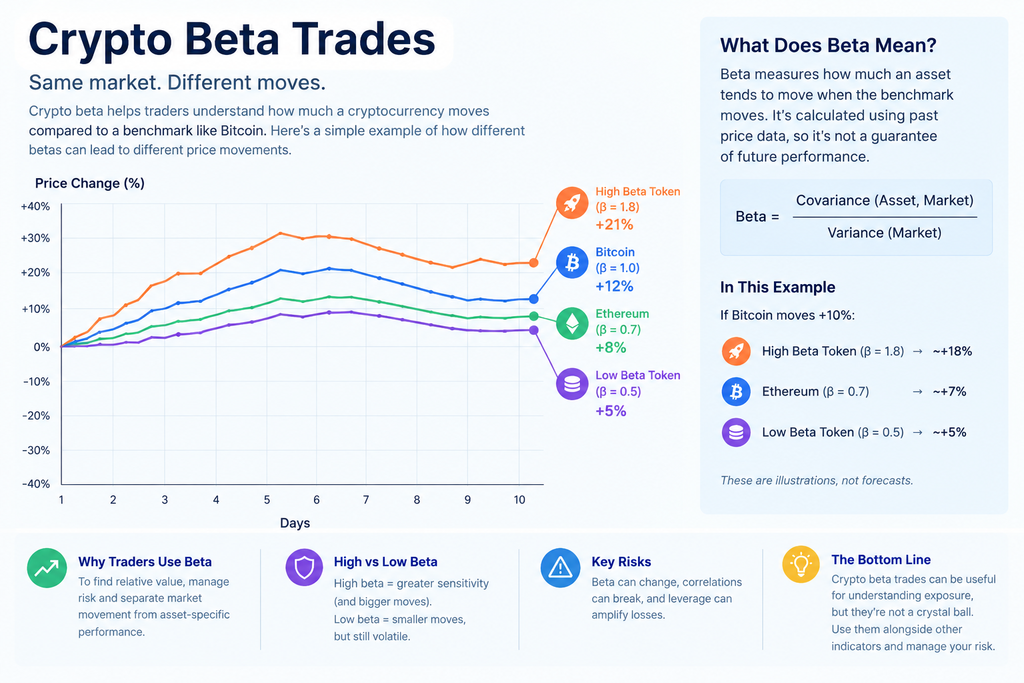
How Is Crypto Beta Calculated?
Beta is generally estimated by comparing the returns of an asset with the returns of a benchmark.
A simplified formula is:
Beta = Covariance (Asset Returns, Market Returns) ÷ Variance (Market Returns)
For crypto, the benchmark could be:
- Bitcoin
- A crypto market index
- A broad digital-asset index
- Another cryptocurrency
The choice of benchmark matters.
An altcoin’s beta to Bitcoin can be different from its beta to a broad crypto index.
Research on crypto-market beta specifically highlights the difficulty of choosing an appropriate market index and estimating stable beta relationships.
Read More: What Happens When Bitcoin Reaches 21 Million Supply?
Beta vs Correlation
Beta and correlation are related, but they measure different things.
Correlation tells you how closely two assets tend to move together.
Beta tells you how much one asset tends to move when the reference asset moves.
For example, two tokens can have a high correlation but very different betas.
| Measure | What it tells you |
|---|---|
| Correlation | How closely two assets move together |
| Beta | How strongly one asset tends to move relative to another |
| Volatility | How much an asset’s price fluctuates |
| Alpha | Return not explained by the selected factors |
This distinction is particularly important in crypto because assets can move in the same direction while producing very different percentage returns.
Why Do Crypto Beta Trades Exist?
Crypto markets contain assets with very different risk profiles.
Bitcoin may move 3% while a smaller altcoin moves 8% in the same direction. During a sharp market sell-off, the difference can become even larger.
That creates potential opportunities for relative-value strategies.
A trader might therefore look for:
- High-beta versus low-beta assets
- Bitcoin versus altcoins
- One sector versus another
- Market-neutral positions
- Long-high-beta and short-low-beta combinations
- Hedging strategies
The underlying idea is to separate market exposure from asset-specific performance.
High-Beta Crypto Trades
A high-beta cryptocurrency tends to have greater sensitivity to movements in its chosen benchmark.
For example, if an asset has a historical beta of 1.8 to Bitcoin, it has historically moved about 1.8 times Bitcoin’s percentage movement, on average over the measurement period.
High-beta trades can therefore provide greater exposure to market movements.
But the same characteristic works in both directions.
A larger move upward can be accompanied by a larger move downward.
Read More: What Is a Tokenised Bond? How India’s First Blockchain Bond Works and Why It Matters
Low-Beta Crypto Trades
A low-beta asset has historically shown less sensitivity to the selected benchmark.
If its beta to Bitcoin is 0.5, a 10% Bitcoin move would correspond to an estimated 5% move under the simplified beta relationship.
This does not mean the asset is necessarily safer.
A cryptocurrency can have a low beta to Bitcoin while still experiencing significant asset-specific volatility.
How Do Beta Trades Work?
A basic beta trade can be broken into several steps.
Step 1: Choose A Benchmark
The trader first chooses the reference asset or market index.
Bitcoin is often used because it is the largest and most widely followed cryptoasset, but a broader index may be more appropriate depending on the strategy.
Step 2: Calculate Historical Beta
Historical price data is used to estimate the asset’s beta.
The result depends on:
- Time period
- Return frequency
- Benchmark
- Calculation method
- Market regime
Step 3: Compare Assets
The trader can then compare beta values across assets.
For example:
| Asset | Historical Beta to BTC |
|---|---|
| Asset A | 0.7 |
| Bitcoin | 1.0 |
| Asset B | 1.4 |
| Asset C | 1.9 |
These numbers are illustrative.
Step 4: Build the Trade
The trader may take a long position in one asset and a short position in another, depending on the strategy.
The goal can be to reduce broad market exposure and focus on the difference in performance.
Step 5: Monitor Beta
This step is often overlooked.
Beta can change.
A strategy that worked when markets were calm may behave differently during a sharp rally, sell-off or liquidity shock.
How Well Do Crypto Beta Trades Work?
This is where the answer becomes less straightforward.
Research suggests that crypto beta trades can be useful as a framework for understanding market exposure, but their effectiveness as a consistently profitable or reliable trading strategy is far from guaranteed.
A 2025 study in Financial Innovation examined the predictability of crypto-market betas and beta-hedged portfolios. It found that historical betas were substantially less predictive of future crypto betas than comparable measures in US equities. The study also found that beta-hedged portfolios reduced variance for only around 17% of the crypto universe examined.
The researchers concluded that crypto-market betas tend to be unstable and that hedging effectiveness depends heavily on the market index and methodology used.
That does not mean beta analysis is useless.
It means that a historical beta should not be treated as a permanent characteristic of a cryptocurrency.
Why Crypto Beta Can Change
Several factors can cause beta to change.
Market Regimes
Crypto markets can behave differently during bull markets, bear markets and periods of extreme volatility.
An asset that historically moved 1.5 times Bitcoin may not maintain that relationship during a market shock.
Liquidity
Smaller tokens can have thinner order books. Large trades can therefore cause significant price movements.
Token-Specific Events
A token’s beta can change after:
- Protocol upgrades
- Token unlocks
- Major listings
- Regulatory developments
- Security incidents
- Governance changes
- Major partnerships
These events can create price movements that have little to do with Bitcoin.
Changing Market Structure
The cryptocurrency market itself continues to evolve.
Institutional participation, derivatives, ETFs, changing liquidity and increasing connections with traditional financial markets can affect relationships between crypto assets.
Recent research from the Federal Reserve Bank of Chicago found that Bitcoin’s exposure to broad US equity-market movements increased substantially over time, with its estimated equity beta becoming statistically positive around 2020.
Crypto Beta vs Bitcoin
Bitcoin is commonly used as a benchmark for altcoin beta.
A simplified example:
Altcoin return = Alpha + Beta × Bitcoin return + Other factors
The “other factors” are important.
An altcoin’s price can be affected by factors specific to that project, sector, liquidity conditions and broader market sentiment.
Therefore, even a correctly estimated beta cannot explain every price movement.
Does Higher Beta Mean Higher Returns?
Not necessarily.
A higher beta means greater historical sensitivity to the chosen benchmark. It does not automatically mean higher future returns.
For example, if Bitcoin rises sharply, a high-beta token may outperform.
But if Bitcoin falls sharply, the same high-beta relationship can work against the position.
Beta should therefore be viewed primarily as a measure of market sensitivity, not a return guarantee.
Beta Trading Strategies
There are several ways traders can use beta information.
Long High-Beta Assets
A trader expecting strong market momentum may consider assets that have historically shown higher beta.
The risk is that a market reversal can produce larger losses.
Long Low-Beta Assets
A trader may prefer assets with lower market sensitivity when looking to reduce exposure to broad crypto movements.
However, low beta does not eliminate volatility.
Long-Short Beta Trades
A more advanced approach involves going long one asset and short another.
For example:
Long: lower-beta asset
Short: higher-beta asset
or the reverse, depending on the trader’s market view.
The objective is to isolate relative performance.
Beta Hedging
Beta can also be used to estimate how much of a portfolio’s exposure is linked to broad market movements.
A trader may use another asset or derivative to offset part of that exposure.
Research shows, however, that crypto beta hedging can be difficult to implement consistently because beta estimates are unstable and asset-specific risk remains significant.
Risks of Crypto Beta Trades
Beta strategies come with several risks.
Beta Is Backward-Looking
Beta is calculated from historical returns.
It tells you how an asset behaved during a particular period, not necessarily how it will behave tomorrow.
Beta Depends on The Window
A 30-day beta can be very different from a one-year beta.
Shorter periods can respond quickly to changing market conditions but may be noisy. Longer periods can provide more observations but may hide recent changes in market behaviour.
Correlations Can Break
Two assets may have historically moved together but suddenly diverge.
This can be particularly important during major market events.
Leverage Magnifies Losses
Many beta strategies use futures or perpetual contracts.
Leverage can amplify both gains and losses and can result in liquidation if positions move significantly against the trader.
Funding Costs
Perpetual futures positions can involve funding payments.
Even if the price relationship behaves as expected, funding costs can reduce the strategy’s overall return.
Liquidity Risk
Smaller tokens can experience wider spreads and greater slippage, making it difficult to enter or exit positions at expected prices.
Does Beta Trading Work Better in Crypto?
There is no universal answer.
Beta can be useful for measuring exposure, comparing assets and designing risk-management frameworks. But evidence does not support treating crypto beta as a consistently stable trading signal.
A 2024 study examining Bitcoin and Ethereum found that their estimated systematic risk increased substantially between 2015 and 2023, with Bitcoin’s beta rising from 0.032 to 0.834 and Ethereum’s from 0.087 to 1.003 in the study’s framework. The authors concluded that this change reduced some of the diversification benefits previously associated with crypto.
This illustrates why beta should be monitored rather than calculated once and forgotten.
How Traders Can Use Beta Carefully
A more practical approach is to treat beta as one input among several.
Traders can consider:
- Historical beta
- Correlation
- Volatility
- Trading volume
- Liquidity
- Funding rates
- Open interest
- Market regime
- Asset-specific news
- Time horizon
Looking at several measures can provide more context than relying on one beta figure.
A Simple Beta Trade Example
Suppose a trader analyses two assets:
| Metric | Asset A | Asset B |
|---|---|---|
| Beta to BTC | 0.8 | 1.6 |
| Historical volatility | Lower | Higher |
| Liquidity | Higher | Lower |
If the trader expects Bitcoin to experience a strong directional move, Asset B may show greater sensitivity based on its historical beta.
But if Bitcoin moves sharply in the opposite direction, the same characteristic can increase losses.
The example demonstrates the central idea of beta trading: greater sensitivity works in both directions.
Are Crypto Beta Trades Suitable for Everyone?
Not necessarily.
Understanding beta does not require actively trading a beta strategy. It can simply help investors understand how a cryptocurrency has historically behaved relative to Bitcoin or another benchmark.
More complex strategies involving short selling, futures, perpetual contracts or leverage require a much deeper understanding of market mechanics and risk.
Final Takeaway
Crypto beta trades are based on the idea that different cryptocurrencies respond differently to movements in a broader market or benchmark such as Bitcoin. Beta can help traders measure that sensitivity and construct relative-value or hedging strategies.
However, crypto beta is not fixed. Research has found that beta relationships in cryptocurrency markets can be unstable, difficult to forecast and heavily influenced by the benchmark and market conditions.
For that reason, beta is better viewed as a risk and market-exposure measurement rather than a standalone trading signal. Anyone considering a beta-based strategy should also account for volatility, liquidity, leverage, funding costs and the possibility that historical relationships may change.
Risk disclaimer: Crypto assets are highly volatile and can result in substantial losses. Futures, perpetual contracts and leveraged trades carry additional risks, including liquidation. Historical beta or past performance does not guarantee future results. This article is for educational purposes and should not be considered investment advice.