Written by
  Reviewed by
Introduction: Bitcoin Reaches 21 Million Supply
Central banks love the print button. Traditional money is explicitly engineered to lose value through endless, systematic dilution. Bitcoin turns that entire model upside down with an unyielding economic firewall: a hard supply cap locked at exactly 21 million units. Satoshi Nakamoto wrote this rule directly into the genesis code.
With more than 95% of all coins already circulating out in the wild, the countdown to the final fraction of a token is actively ticking away. Let’s look past the speculative internet hype and focus purely on the structural mechanics.
Quick Summary
Hit the cap, and the protocol completely stops creating new coins. Period. The network won’t freeze, crash, or stall its database. Instead, the economic model shifts entirely to a self-sustaining transaction fee ecosystem. Miners lose their regular block subsidies and must live entirely off the transaction tips users pay to compete for limited block space. The asset officially transitions from an expanding digital currency into a completely fixed, deflationary commodity.
Latest Updates
The on-chain landscape is closing in on the final boundary line faster than most people realize:
- The 20 Millionth Coin Crossed: In March 2026, the network hit a massive milestone at block height 939,999. Foundry USA officially mined the 20 millionth Bitcoin, leaving less than 5% of the total lifetime supply left to be minted over the next century.
- Layer-2 Fee Scaling: Advanced optimization tools and Lightning Network batching channels are scaling up heavily right now. The goal is to prepare the base chain to handle premium settlement value as block rewards continue to shrink.
- The Core Cap Consensus: Blockchain infrastructure groups keep modeling long-term network hashpower security without inflation. The global consensus among node operators to defend the 21 million limit remains completely bulletproof.
What is it?
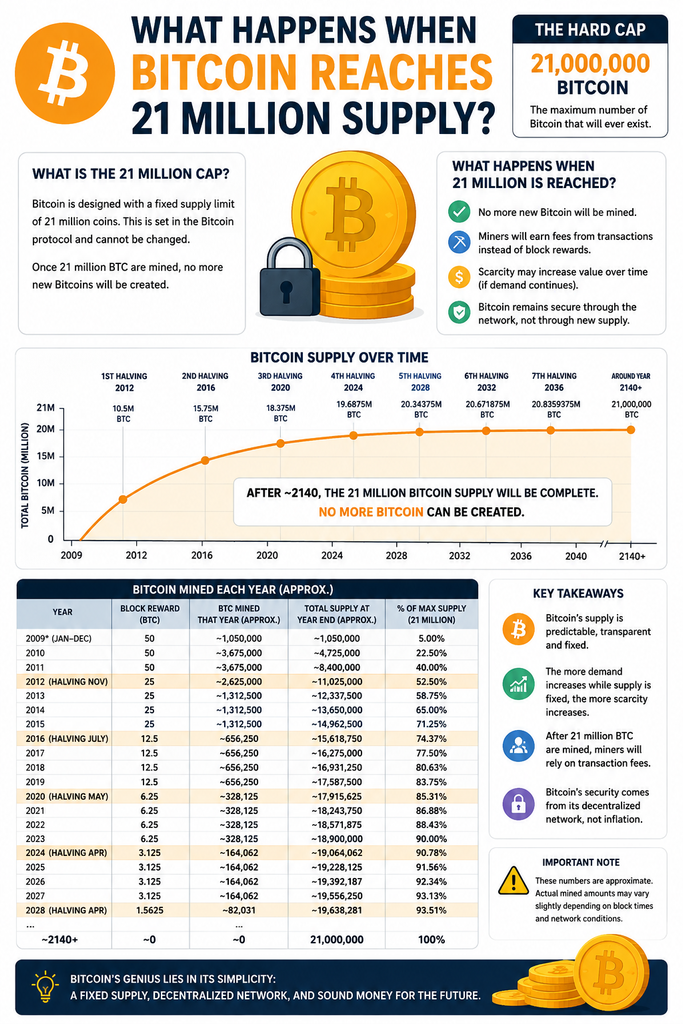
The 21 million limit is the mathematical endgame of Bitcoin’s distribution schedule. The network births new coins into the ecosystem roughly every ten minutes by paying a block reward to miners. To protect against inflation, this reward slashes precisely in half every 210,000 blocks—roughly every four years. This programmatic decay runs like clockwork until the emission rounds down to the smallest possible unit.
Why it Matters
The block subsidy is the primary financial carrot keeping the entire network safe. It pays millions of high-powered computers across the planet to secure the ledger against malicious double-spend attacks. If the block subsidy vanishes and organic transaction fees cannot cover basic operational electricity costs, miners will switch off their machines. That threatens the security of billions in decentralized wealth.
Read More: Bitcoin Halving Explained: What It Is and What Indian Investors Should Expect
How it Works
The final countdown and transition phase run on a strict mathematical script:
- The Halving Grind: The block reward continuously decays over the next few decades, dropping from the current 3.125 BTC down to microscopic fractions of a single satoshi.
- The Final Mint: Around the year 2140, the software triggers the final programmatic halving, dropping the block reward to absolute zero forever.
- The Codebase Vault: The Bitcoin protocol automatically rejects any future block that attempts to manufacture new supply out of thin air.
- The Fee Economy Takeover: Miners adapt completely, sustaining their hardware businesses purely on user transaction fees inside the open market for block space.
Key Features
- Absolute Code Scarcity: Ironclad mathematical finality. The protocol codebase guarantees the total circulating supply can never cross the maximum limit of 20,999,999.9769 BTC. Total, uncompromising immunity to global monetary debasement and central bank money printing. Period.
- Pure Fee-Driven Compensation: A complete economic evolutionary leap. It completely transforms the underlying network security model by phasing out inflationary minting entirely.
- Decentralized Difficulty Readjustments: Continuous, automated algorithmic self-correction. Every single window of 2,016 blocks, the protocol evaluates global hashpower and adjusts computational difficulty.
- Permanent Ledger Continuity: Absolute baseline stability. The underlying blockchain doesn’t hit a wall, freeze, or alter its structural operational architecture when the minting stops. Transactions get validated, cryptography rules are strictly enforced, and the ledger rolls forward seamlessly.
- Irreversible Sat-Level Divisibility: Massive scaling potential hidden in microscopic units. While the headline number is locked at 21 million, each individual coin splits perfectly down to 100 million satoshis (108). Absolute macro scarcity combined with infinite micro-transaction volume.
- Asymmetric Security Settlement Priority: Ultra-premium base-layer mechanics. With block space at an absolute premium, the core layer transforms into an elite, high-value global settlement highway. Small retail transactions naturally migrate to Layer-2 networks, reserving the main chain for high-fee institutional finality.
Benefits & Risks
The single greatest benefit is absolute digital scarcity—the perfect long-term store of value and an ironclad shield against structural inflation. The main risk is hashrate volatility. If network transaction fees aren’t high enough to cover data center operating costs when the subsidy dies, inefficient operators will go bankrupt. That lowers the computing power protecting the chain until the automated difficulty adjustment re-balances the playground.
Read More: Bitcoin Options Trading App in India
Real-world Examples
- The Exchange Supply Squeeze: Massive institutional funds, multi-billion dollar spot ETFs, and ultra-conviction diamond-hand wallets are aggressively sweeping liquidity off active platforms. The circulating supply is drying up on exchanges right now. We are witnessing an structural inventory shock decades before the final coin is ever minted.
- The Ordinals Fee Explosions: On-chain digital inscriptions completely flooded the base network. Transaction queues exploded overnight, sending fees sky-high. The organic tips paid to miners completely bypassed the value of the standard block subsidy itself. That is absolute proof that a pure fee economy can fund network security.
- The Block 501,726 Blunder: A historical mining anomaly where an operator accidentally forgot to claim their new block subsidy in the mining transaction code. The protocol showed zero mercy. It permanently burned those coins, proving the codebase never allows a secondary recovery of lost supply. Once gone, it is gone for good.
Comparison Table
| Economic Metric | Current Emission Era (Pre-2140) | Post-Emission Era (Post-2140) |
|---|---|---|
| New Supply Generation | Predictable rewards minted every 10 minutes | Strictly zero; no new coins can ever enter existence |
| Miner Revenue Structure | Main block subsidy + extra transaction fees | Funded completely by user transaction fees |
| Total Circulating Supply | Growing slowly toward the hard cap limit | Completely locked at just under 21 million units |
| Network Security Model | Heavily subsidized by protocol inflation | Driven entirely by market demand for block space |
Expert Insights
The shift to a fee-only market will be a slow crawl rather than a sudden economic shock. By the late 2030s, the block reward will drop well below one single Bitcoin. The market has more than a century to naturally price the value of secure block space and develop secondary layers before the final printing press shuts down forever.
Common Mistakes/Myths
- The “Network Brakes” Myth: Beginners often assume the blockchain will stop working once the 21 million cap is hit. Transaction processing stays completely identical; only the way miners get paid changes.
- The “Not Enough Supply” Fallacy: Fearing that a fixed cap stops global adoption ignores extreme divisibility. Because you don’t need to buy a whole coin, breaking Bitcoin down into satoshis ensures infinite transactional capacity.
Future Outlook
As the block subsidy decays over the next few decades, the survival of the network depends completely on massive transaction utility. Expect ultra-fast layer-2 and layer-3 protocols to process minor everyday payments off-chain, while the base layer morphs into a premium, high-fee institutional finality machine.
Conclusion
Bitcoin’s path toward its 21 million supply limit is a profound monetary experiment. The end of the block reward isn’t a system failure; it is the ultimate realization of an immutable economic framework. By completely shedding inflation and tying its survival to organic user demand for secure settlement space, the network cements its long-term future. Keep your private keys locked down, ignore short-term market noise, and watch the world’s scarcest digital asset complete its century-long macroeconomic script.
FAQs
1. What is Bitcoin’s 21 Million Supply?
An ironclad protocol rule capping the maximum lifetime creation of Bitcoin at exactly 21 million units. As of mid-2026, the network has already mined the 20 million mark, meaning under 5% of the total supply is left to enter existence.
2. Why is Bitcoin’s 21 Million Supply important?
Because central banks print infinite fiat currency, destroying your purchasing power. Bitcoin fixes this. It provides absolute, code-enforced digital scarcity, creating a borderless store of value immune to artificial inflation and political manipulation.
3. How does it work?
Through automated, code-driven issuance. New coins drop roughly every ten minutes as a reward to miners. To keep supply tight, the code triggers a “halving” every four years, cutting the output directly in half. The emission schedule rounds down to absolute zero around the year 2140.
4. What are the risks or benefits?
Benefits: Absolute scarcity, ultimate long-term value preservation, and an ironclad inflation hedge.
Risks: Potential hashrate volatility. Once the block subsidy drops to zero, miners must survive solely on user transaction fees. If fees fail to cover electricity bills, computational power drops until the difficulty self-corrects.
5. What should beginners know about Bitcoin’s 21 Million Supply?
The network won’t crash or freeze when the cap is hit; it shifts flawlessly to a pure transaction fee economy. You also don’t need to buy a whole Bitcoin. Every coin splits into 100 million smaller pieces called satoshis, unlocking infinite global scaling capacity.