A crypto wallet address tells the blockchain where to drop your digital assets. In other words, it is like your bank account number in the crypto universe to receive digital assets on a blockchain. That’s it. No names, no second chances, no “Are you sure?” confirmations. If the address is right, the transfer lands. If not, it vanishes into a wallet nobody controls. That’s why knowing what a wallet address is—and how it works—matters from day one. It’s not complex once you look under the hood, but skipping the basics? That’s how people burn $1,000 trying to move $100.
What Is a Crypto Wallet Address?
Let’s keep this tight: a crypto wallet address is what people use to send you coins. Think of it as your public dropbox on the blockchain. When someone says, “Send me your wallet address,” they mean, “Give me the exact code that tells the network where to send funds.”
Here’s how it gets made. First, your wallet generates a private key—a secret string only you should ever see. From that, it derives a public key. Then it compresses that public key into your wallet address using specific hashing rules depending on the chain. For Bitcoin, it runs SHA-256 and RIPEMD-160. For Ethereum, it’s Keccak-256. The output? A weird-looking string that holds serious weight.
The address is public. The key stays private. That line is non-negotiable.
How Crypto Wallet Addresses Work
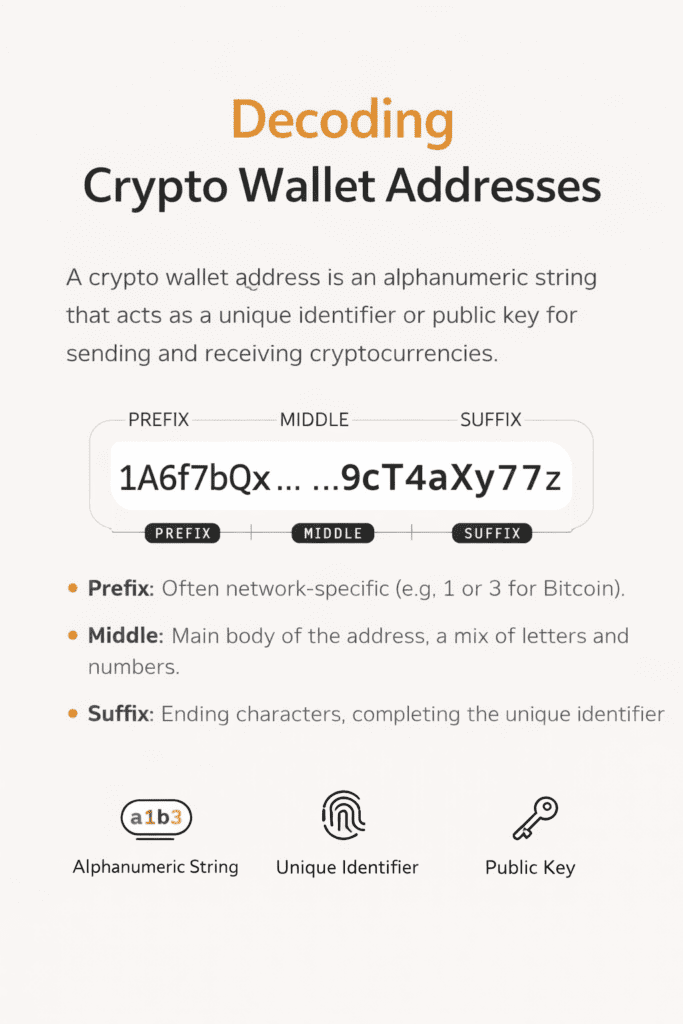
Here’s the breakdown: the wallet address is where your crypto lands. The private key is how you unlock it later. Two roles. Zero overlap.
When you send crypto to someone, your wallet signs the transaction using your private key. The blockchain doesn’t check your name, your ID, or your reputation. It checks the math. That’s it. If the signature is valid and the funds exist, the transaction goes through. Done.
Your private key never leaves your device. Your public address can be printed on a billboard. The blockchain doesn’t care who you are—it only cares if the signature lines up with the destination. And once that happens, the record becomes permanent. Final. Immutable.
It’s fast. It’s how crypto works.
Read More: What are crypto wallets, & how do they work?
Types of Crypto Wallet Addresses
Addresses come in different types because blockchains evolved and optimized over time, and because different chains made different design choices.
Bitcoin supports multiple address families. Legacy addresses start with “1” and use P2PKH. P2SH addresses start with “3” and support more flexible scripts, including multisig. SegWit introduced Bech32 addresses that often start with “bc1q,” reducing transaction size and improving efficiency. Taproot introduced Bech32m addresses that start with “bc1p,” supporting advanced scripting with improved privacy characteristics compared to older script patterns.
Ethereum addresses start with “0x” and use a consistent 20-byte format across the Ethereum mainnet and many EVM-compatible networks. The checksum format defined in EIP-55 uses letter casing as a checksum signal, which helps humans and apps spot typos.
Other chains add their own formats. Solana uses base58-style addresses. Ripple uses addresses that typically begin with “r.” Cardano uses Bech32-like encodings.
Public Address vs Private Key
Public address and private key work like a mailbox and the key to open it. Anyone can drop something into the mailbox. Only the key-holder can open it and move the content onward.
The public address is safe to share. It acts as a receive identifier. The private key authorizes outgoing transactions and proves ownership. Losing the private key locks you out permanently. Sharing the private key hands control away instantly.
Different Wallet Address Formats
Address formats act like fingerprints for each chain and era.
Bitcoin commonly shows:
- Legacy P2PKH addresses that start with “1”
- P2SH addresses that start with “3”
- SegWit Bech32 addresses that start with “bc1q”
- Taproot Bech32m addresses that start with “bc1p”
Ethereum shows a 42-character hexadecimal address starting with “0x.” Many wallets display the checksummed variant based on EIP-55 because it helps detect typing errors.
Read More: How to Set Up a Crypto Wallet India: A Simple Guide
How to Create a Crypto Wallet Address
You choose the wallet type, complete setup, and the wallet generates your seed phrase and your first receive address.
You can create an address with:
- A software wallet, such as a browser extension or mobile app
- A hardware wallet, which keeps keys on a dedicated device
- A custodial wallet on an exchange, where the platform controls keys and issues deposit addresses
Step-by-Step: Creating a Wallet Address Using Software Wallets
- Download the wallet from the official source only
- Create a new wallet and trigger seed generation
- Write the seed phrase offline and complete in-app verification
- Set a strong local password or device lock
- Open the Receive or Deposit screen to view the address
- Generate a fresh address if rotation is supported
- Send a small test transfer before moving larger funds
Step-by-Step: Creating a Wallet Address Using Hardware Wallets
- Buy the device from an official seller and inspect the packaging
- Connect the device and install the official companion app
- Initialize the device and set a secure PIN
- Generate the seed phrase directly on the device screen
- Install the required coin apps on the device
- Open the Receive screen and verify the address on-device
- Sign transactions with the device and store the seed offline permanently
How to Find Your Wallet Address
Finding your address is straightforward once you know where wallets hide it.
Open your wallet and tap “Receive” or “Deposit.” The wallet displays the address string and a QR code. Desktop wallets often show a receiving tab. Browser wallets often show the address near the top of the account view. Exchanges show deposit addresses under the asset’s deposit page, often with a required network selection for chains that support multiple routes.
How to Share a Crypto Wallet Address Safely
Sharing a wallet address is normal, but sharing it carelessly creates avoidable risk.
Use the wallet’s copy button rather than typing manually. Prefer QR codes when the sender is physically present or when the app supports scanning. Before the sender hits confirm, compare the first and last characters with what your wallet displays.
Common Mistakes to Avoid When Using Wallet Addresses
Most wallet address mistakes follow a handful of patterns.
People send funds on the wrong network, such as using an Ethereum-style address on the wrong chain selection inside an exchange. People paste an address and fail to notice that clipboard malware replaced it. People reuse addresses excessively and expose transaction patterns. Users often confuse public address sharing with key sharing and expose secrets.
Bitcoin address types also cause confusion. Users see “1”, “3”, “bc1q”, and “bc1p” prefixes and assume they all behave the same. They do not. Wallets and platforms must support the format you use.
Are Crypto Wallet Addresses Safe?
Wallet addresses are safe to share, because addresses alone do not authorize spending. The risk concentrates around key management and transaction finality.
Blockchains verify ownership through signatures and public key cryptography. Transactions remain irreversible once confirmed. That design removes intermediaries and chargebacks, which increases user responsibility.
Best Practices for Securing Wallet Addresses
- Use HD wallets to rotate addresses and reduce on-chain tracking
- Keep long-term funds in hardware wallets, daily funds in software wallets
- Enable multisig for large balances to avoid single-key control
- Store the seed phrase offline, never on internet-connected devices
- Use durable backups like metal for seed phrase storage
- Treat the seed phrase as the only recovery key and protect it accordingly
Conclusion
A wallet address might look like random text, but it’s one of the most important parts of your crypto portfolio. It’s like your UPI ID, but only for crypto. It gives the senders an idea about where to send the funds or from where the cryptos will come. So, if you are starting your crypto investment or trading, it’s important that you understand everything about the wallet address.
FAQs
1. How to create a crypto wallet address?
First, download a crypto wallet, create a new wallet, and secure the seed phrase. Then open the receive section, and your wallet will generate your wallet address right away.
2. What is an example of a crypto wallet address?
A Bitcoin wallet address looks like bc1qxy2kgdygjrsqtzq2n0yrf2493p83kkfjhx0wlh.
An Ethereum wallet address looks like 0x742d35Cc6b1528f38c0fa9cD6a5070e231c0a3b4.