Introduction
If you’ve traded for any length of time, you’ve probably seen this happen:
Price moves toward a key level, suddenly breaks it, triggers stop-losses—and then reverses sharply.
That frustrating move is often called a liquidity grab.
Many beginner traders mistake it for a breakout. Experienced traders often look for it as an opportunity.
Understanding liquidity grabs can help you:
- avoid false breakouts,
- improve entries,
- place smarter stop-losses,
- and understand how large market players operate.
Let’s break it down.
What Is a Liquidity Grab?
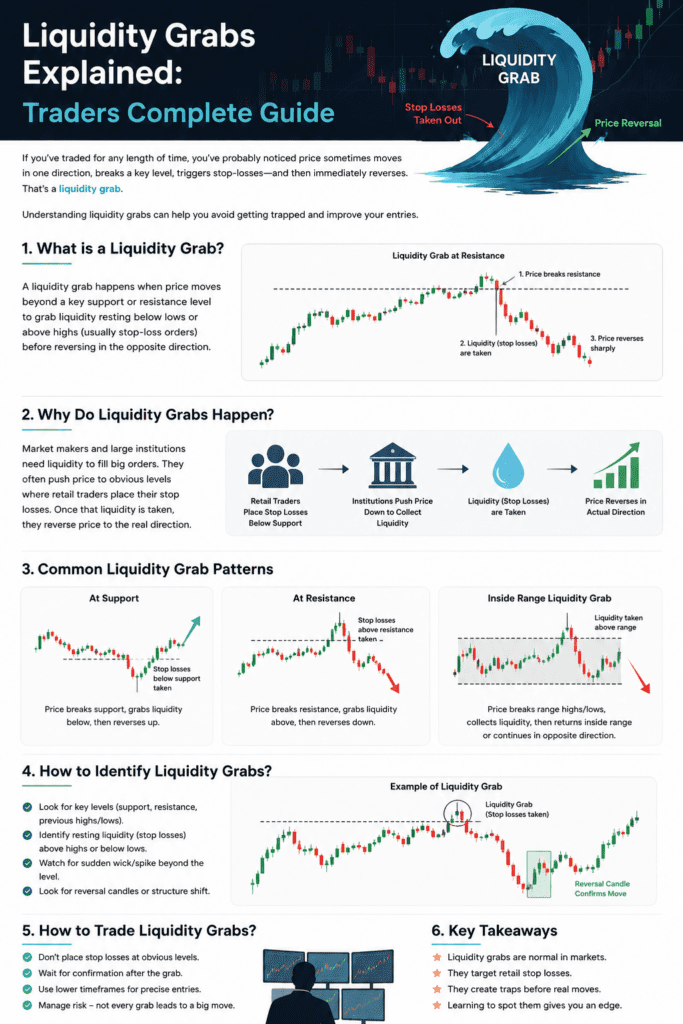
A liquidity grab happens when the price temporarily moves beyond an important support or resistance level to capture pending orders—especially stop-losses—before reversing.
Typical targets:
- stop-losses below support
- stop-losses above resistance
- breakout entries
- resting liquidity zones
After collecting liquidity, the price often moves in the real intended direction.
Why Do Liquidity Grabs Happen?
Markets need liquidity.
Large institutions cannot always execute huge orders instantly without moving price.
To solve this, they often target zones where retail traders place:
- stop-losses
- pending buy/sell orders
This creates enough volume for bigger participants.
Simple process:
- Retail traders place stops.
- Institutions push prices into that zone.
- Stops trigger.
- Liquidity gets collected.
- Price reverses.
This is why traders call it stop-loss hunting.
Types of Liquidity Grabs
1. Buy-Side Liquidity Grab
Price moves above resistance, triggers buy stops, then falls.
Common in:
- fake bullish breakouts
- resistance zones
2. Sell-Side Liquidity Grab
Price moves below support, triggers sell stops, then rises.
Common in:
- fake breakdowns
- support zones
3. Range Liquidity Grab
Occurs inside a consolidation zone.
Price sweeps one side of the range before reversing.
Read More: What is liquidity?
Liquidity Grab vs Liquidity Sweep
These terms are often confused.
| Feature | Liquidity Grab | Liquidity Sweep |
|---|---|---|
| Duration | Short | Can last longer |
| Purpose | Trigger stops | Clear broader liquidity |
| Movement | Quick reversal | May continue before reversing |
| Common Use | Intraday trading | Swing trading |
Both involve stop clusters.
How to Identify a Liquidity Grab
Watch for these clues:
1. Key Support/Resistance Levels
Liquidity grabs often happen near:
- daily highs/lows
- trendline breaks
- previous swing highs/lows
2. Sudden Wick or Spike
A long candle wick is common.
This signals:
“price tested beyond the level but failed.”
3. Volume Spike
Higher volume may indicate liquidity collection.
4. Immediate Reversal
A quick reversal confirms the trap.
Example of a Liquidity Grab
Imagine:
Bitcoin trades near the $100,000 resistance.
Retail traders place:
- Buy breakout orders above $100,000
- Stop-losses near $100,200
Price jumps to $100,250.
Everyone thinks breakout.
Minutes later, the price drops to $98,500.
That was a liquidity grab.
How to Trade Liquidity Grabs
Wait for the Sweep
Don’t enter too early.
Let price take liquidity first.
Look for Confirmation
Use:
- reversal candles
- structure breaks
- volume confirmation
Enter After Reversal
Trade after confirmation—not during the spike.
Place Smart Stop Loss
Avoid obvious levels.
Place stops beyond structural invalidation.
Manage Risk
Not every sweep reverses.
Always use position sizing.
Common Mistakes Traders Make
Chasing Breakouts
Most beginners buy the fake breakout.
Placing Obvious Stops
Crowded stop placement attracts liquidity grabs.
Ignoring Volume
Volume often tells the story.
Entering Without Confirmation
Patience matters.
Best Markets for Liquidity Grab Trading
Liquidity grabs appear in:
- crypto
- forex
- stocks
- futures
- commodities
They are especially common in high-volatility markets like crypto.
Read More: Investment Fluctuation Reserve: Meaning, Importance & How It Works
Why Liquidity Grabs Matter in Crypto
Crypto trades 24/7 and often has:
- sharp wicks
- lower weekend liquidity
- leveraged traders
This makes liquidity grabs more frequent.
Popular examples:
- BTC
- ETH
- SOL
Tools to Spot Liquidity Grabs
Useful tools:
- volume profile
- order book
- candlestick charts
- market structure analysis
- support/resistance zones
Conclusion
A liquidity grab is not random.
It is often a deliberate move to collect orders before price moves.
Once you understand this concept, you can:
- stop chasing fake breakouts,
- improve timing,
- and trade with more confidence.
Many traders lose money to liquidity grabs.
Smart traders learn to trade them.
FAQs
1. What is a liquidity grab in trading?
A liquidity grab is when the price briefly moves beyond a key level to trigger stop-losses before reversing.
2. Is a liquidity grab the same as stop-loss hunting?
They are closely related. Liquidity grabs often involve triggering retail stop-losses.
3. How do I identify a liquidity grab?
Look for sudden wicks, volume spikes, and quick reversals near major levels.
4. Are liquidity grabs common in crypto?
Yes. Due to high volatility and leverage, liquidity grabs are very common in crypto markets.